Announcements
Get free breathing and awareness practices, insights, and tips on my Facebook Public Figure Page
Identification: Teachings from the Gurdjieff Work
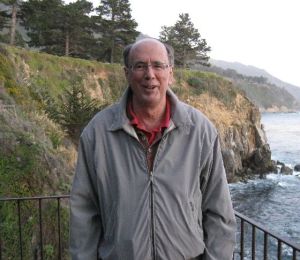
Dennis at Esalen in 2009
“It’s as though you go out one day from your apartment to a drugstore to buy some toothpaste,” my teacher replied. “Of course, you know that your real motivation for going out is that you wish to meet the woman of your dreams, and you have the feeling that you might meet her today. Keeping your eyes open for the woman of your dreams, you head over to the toothpaste display and become engrossed in deciding which of the many brands you should buy—checking prices and so on, and deciding which one would be the best for your teeth. In the meantime, God has sent the woman of your dreams into the store and she is standing near the cash register at that very moment. But you are so engrossed in deciding which toothpaste to buy that you don’t even look up. By the time you’ve decided on which brand to buy, she’s left the store and you never even noticed.”
It is clear to me today how much of my life takes place like this–in narrow, unconscious identification with the contents of my awareness, however seemingly consequential or inconsequential they might be. And, yet, that too is part of waking up to what actually is. For in those moments of seeing this process of identification in action, I experience a new appreciation for the statement that “the truth shall set us free.” And this enables me to relax into the immense freedom of the unknown, where the direct experience of I Am is more real than the thought of I am this or that.
Copyright 2008-2010 by Dennis Lewis. Taken from “In-Sights” on my website The Center for Harmonious Awakening.
The Harmony of Mindful Breathing

The Harmony of Mindful Breathing
Yogis, qigong practitioners, meditators, and alternative health practitioners have known for many years that conscious, natural breathing can help reduce stress, increase relaxation, and facilitate healing. In her groundbreaking book Molecules of Emotion, neuroscientist Candace Pert lends scientific support to this view when she tells us that bringing our attention to our breathing during meditation brings many such benefits. According to Pert, mindful breathing helps us “enter the mind-body conversation without judgments or opinions, releasing peptide molecules from the hindbrain to regulate breathing while unifying all systems.”
In a phone conversation I had with her on May 9, 1995, Pert pointed out that the part of the brain that controls breathing is located at the fourth ventrical of the floor of the brain. This is the same location the secretes many neuropeptides, which, among other actions, modulate our feelings, which, of course, have an enormous influence on almost every aspect of how we function.
What is important to take from these physiological facts is that the way we breathe can have a powerful influence on the relationship between mind, emotions, and body. If our breathing is disharmonious, for example, the relationships between these functions will also be disharmonious, resulting in poor communication between them and little sense of real wholeness.
A big help in improving communication, harmony, between these functions is to practice following, being present to, your breathing. In this practice, you simply use your inner attention to follow, to sense, your inhalations, exhalations, and any natural pauses between for several breaths. When sensing your breathing, it is important not to attempt to manipulate it or control it in any way. Any effort to do so, especially an effort driven by your thoughts or emotions, will most likely bring or exacerbate disharmony.
If you really wish to reduce stress, increase relaxation, and improve communication between thinking, feeling, and sensing, one approach is to sit quietly each day for at least 15 minutes in touch with the whole sensation of your body, including the subtle inner and outer movements of your breath. Sit on a chair or cushion with your eyes closed and your hands either together in your lap or palms down on your knees. Sense your weight being supported by the earth, and allow the entire sensation of your body to come alive inside your awareness.
Once your mind and body become very quiet and you are in touch with the overall sensation of your body, pay particular attention for several breaths first to the air entering and leaving your nose, noticing the warmth or coolness of the air. Then gradually (and progressively) expand your attention to include the movement of air into and out of not only your nose, but also your throat, trachea, and lungs. Sense how the air feels as it moves through the airways and notice any “electric charges” as the air intimately touches the tissues through which it moves.
As you undertake this practice, be careful not to analyze or judge anything you notice about your breathing. Just watch, sense, and feel your breath as it manifests throughout your body. This will help balance your energies and bring your body, mind, and feelings into a more intimate and harmonious relationship.
Copyright 2010 by Dennis Lewis
Living from the Whole of Ourselves: An Excerpt from the Introduction to “Free Your Breath, Free Your Life”
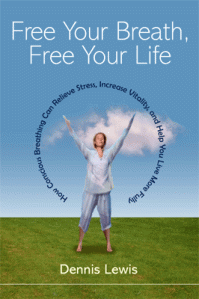
Free Your Breath, Free your Life
The way we breathe, of course, is often a revealing metaphor for our willingness or ability to experience what is actually going on inside ourselves and to move freely through and within our lives and ourselves. For some of us, for example, our restricted, superficial breathing is our unconscious way of suppressing our emotions, of feeling less. Opening up the restrictions in our breathing can help us open up the experiential spaces of our own minds and bodies and learn how to live in the full expanse of the present moment. It is in the spacious reality of the present moment that real exploration, healing, and wholeness can take place.
To live from more of the whole of ourselves is only possible, I believe, when we can fully exhale, when we can let go of everything that is truly unnecessary in our lives. We’re not just talking about a physical act here; we’re also talking about a psychological and spiritual one as well. Can I let go, moment-by-moment, of my narrow, illusory self-image and all the unnecessary muscular tensions and contractions that arise from it? Can I let go moment-by-moment of all the unnecessary and fictitious things, both big and small, that I get attached to and identify with, so that I can receive new, more honest and complete impressions and perceptions of myself and others? Can I live and relate from my wholeness right now instead of from my assumptions, opinions, and judgments based on past experiences and future expectations?
This is what the process of health, healing, and self-transformation is really all about—the inner space and freedom to explore, to be, and to appreciate who or what I already am in my essence. The way we breathe, the way we participate day-by-day in the breath of life—the boundless life force that animates and connects us all—can play a vital role in this intimate exploration.
Copyright 2004-10 by Dennis Lewis.
Civil Discourse

Dennis Lewis
I recently received a FaceBook email from an old San Francisco friend making accusations about someone very close to me. The complete note read (I’ve left out the name and the supposed action): “I suppose you are proud of xxx for doing yyy. I think xxx is a scumbag.”
This was interesting. I hadn’t heard from this man in many years–a man to whom, at his request, I had donated much time without payment for something very dear to him. We also used to spend time together playing tennis and chess, and he was also a guest in my home on a couple of occasions. And here was this accusatory note from him without either a “Hi Dennis” or a signature or real space for civil discourse.
The fact that the accusation was false is not what really concerns me here, though it is troubling enough. People, in their ignorance, make false accusations all the time (I myself have certainly done so). What bothered me most was this man’s lack of even the smallest degree of civility in communicating with me about the issue. No openness. No kindness. No interest in my view.
Of course, one sees incivility everywhere today: on Internet discussion groups, in politics, between governments, and, sadly, between people who call themselves friends. Lack of civility in today’s world is indeed ubiquitous.
Ralph Waldo Emerson said that “There can be no high civility without a deep morality.” And he was right. Civility and “deep morality” go hand in hand, though this is seldom recognized. Emerson was not talking here about the cheap rules of morality, the political correctness that people use as weapons to try to bludgeon one another. No, he was speaking, I believe, about what it means to be truly human.
Unfortunately, we see little discourse today based on civility, especially in the public arena. Making angry accusations is easy, but it is only civility and kindness that allow people to actually listen to one another in a way that enables new understanding and real relationship.
Copyright 2010 by Dennis Lewis
The Gnostic Journal Review of My Book “Breathe Into Being”
This review, by Tony Cartledge, appears in the second issue of The Gnostic: A Journal of Gnosticism, Western Esotericism and Spirituality. The publisher of the journal asked me to wait a couple of months after publication before making this review available to the general public. It has now been two months. I am including the review here because it so beautifully captures the spirit of the book.

Breathe Into Being: Awakening to Who You Really Are
Breathe into Being
Awakening to Who You Really Are
Dennis Lewis, Quest Books
I believe it’s a sign of spiritual health and maturity that, as you get older, you start to see things much more simply. Many unnecessary things fall away, and the lens through which you see the world becomes far less cluttered than it was during the frantic search for meaning of your previous decades. Life becomes a kind of distillation of all you have learned, a distillation down to its essential ingredients.
At least, that is how I see it. So I tend to look for spiritual guidance and instruction that has a simple message and practice. For that reason alone, I knew I was going to find Dennis Lewis’ new book, ‘Breathe into Being,” a valuable addition to my spiritual library.
I’ve had a long interest in the use of following the breath for developing mindfulness, and Dennis Lewis’ work is one of the clearest and most practical expositions of this powerful tool for awakening.
Lewis’ CV, and authority, is impressive, to say the least. He is a graduate of three grand schools of consciousness: the Gurdjieff Work under Lord John Pentland, Advaita Vedanta under Jean Klein, and Taoism under Mantak Chia. Lewis’ approach is a skilful distillation of these three fruitful paths to awakening, with a powerful simplicity and great depth.
In Lewis’ own words, there are few, if any contemporary books that “explore the depths to which breathing itself, natural breathing, is a portal to presence, an ever-present gateway to awakening to and being what you really are.”
There are no lengthy and learned treatises here, but a rich tapestry of around 70 micro-chapters. It is more like a workbook, which Lewis says comes closer to how he actually teaches in a workshop setting.
Each chapter contains a specific practice, and there were many unique exercises that I had not seen before which I immediately incorporated into my daily practice.
Many of these exercises are effective methods for healing tension, undoing the physical and emotional knots and blocks that impede thee free flow of energy in what Lewis calls ‘this amazing temple of awareness’ called the human body.
However, the main focus of these practices is developing non-attachment, or non-identification, gently disengaging our identity away from the ego or personality, and releasing it into that wider ground of being that we are.
Lewis’ practices of simply following the breath are effective tools for generating mindfulness and presence, the space in which we can discover the truth about ourselves and the world.
They are wonderful exercises for developing that most valuable of spiritual commodities: attention.
“The key is simply to be present, to pay attention without any expectation or judgement, to what is happening as you read and practice and live. And it is to realise that being this presence, along with whatever appears within its field of illumination, is the very miracle and meaning for which you have been searching. (Breathe into Being p.8)
Leonardo Da Vinci once said that simplicity is the ultimate sophistication.
Breathe into Being is one of the most sophisticated guides to awakening I have read.
Tony Cartledge
Author of Planetary Types: the Science of Celestial Influence
Everything Becomes Available to You

Sitting with Raven Circling Above
When you give up
your sense of possession,
the hidden lie
of me and mine,
then everything becomes
available to you–
even the expansive sky.
Some Thoughts on Happiness & Suffering
Dennis Lewis
The purpose of our lives, according to the Dalai Lama, “is to seek happiness.”* Although, most of us will agree that what we want most from our lives is happiness, we seldom think and feel and sense deeply about all that this involves.
In most dictionaries, happiness is defined as having to do with luck and good fortune, pleasure and satisfaction. And most of us, most of the time, define our happiness using these sorts of terms in relation to our images of health, family, money, friends, security, jobs, possessions, and so on.
There are moments, however, when we know in our heart of hearts that another, deeper form of happiness exists—the happiness that we feel when we let go of all of our conceptions about who we are and are able to experience the miraculous nature of what we call “ordinary life.” That we exist at all, that we have the opportunity to participate in the extraordinary mystery of life, is the greatest “good fortune” imaginable. Yet, for most of us, the miracle that lies at the heart of our own existence is the one fact that always seems to elude us, the one fact that we always seem to forget.
It does not take much observation of our daily lives to see why we so easily forget. Almost everything in our media-driven culture is designed to suggest that we are lacking something and to entice us to purchase something, to believe something, to be something, or to do something that will “bring happiness.” Society conditions us to a negative self-image, in which whatever we have is never enough. And we identify with these suggestions and influences, as well as with our reactions to them, imagining that our happiness is somehow bound up with them. But, of course, the problem isn’t just the result of our identification with what influences us. The problem is also, and perhaps more centrally, the result of our identification with the images we have of ourselves that allow these influences to shape and define us so deeply. It is these images, many of them negative, that fuel our suggestibility, our assumption that this object, that person, this job, that success, that politician, this spiritual experience, that pursuit will somehow improve our lives, make us better people, and bring us happiness.
And so, we suffer. I am not here talking about the inevitable suffering of war, pain, disease, trauma, and loss. No, I am talking about the unnecessary suffering that we bring on ourselves through chronic negativity. The Dalai Lama points out that it is our negative emotions, especially our anger and hatred, that undermine our physical, psychological, and spiritual well-being and promote conflict and destruction in the world. (Just listen to discussions on FOX News or CNN or talk radio, or better yet to yourself and others discussing the current problems facing us all.) The Dalai Lama also makes clear that “The only factor that can give you refuge or protection from the destructive effects of anger and hatred is your practice of tolerance and patience.”* But who, besides a very small minority of people, actually practice tolerance and patience?
Of course, a lot of our intolerance and impatience, and thus the negativity bound up with them, arises, first, because our self-definitions and expectations of ourselves and others are so often illusory and unrealizable, and second, because even when they are realizable they most often do not reflect who and what we really are, or the actual forces at work in society. Even more important, they do not reflect the miracle of being alive on this earth, and of our great opportunity to engage consciously now in this miracle.
To be alive, in the highest sense of this word, means to be filled with life, to be able to receive, contain, and transform whatever life brings us—until it brings us nothing more. To live life fully and freely means to experience all sides of life as they present themselves to us: joy and suffering, love and hate, pleasure and pain, insight and ignorance, unity and fragmentation, hope and disappointment, clarity and confusion, and so on. This is the only real freedom—the freedom, whether we like or dislike any particular experience, whether we accept it, fight it, or try to change it–is to remember and feel the mystery and miracle of what we have come to call “the ordinary.” For it is this re-membering of our wholeness, this conscious re-connection with and welcoming of all sides of ourselves and our lives, that brings the happiness that we truly wish for.
###
*The Art of Happiness: A Handbook for Living, His Holiness the Dalai Lama and Howard C. Cutler, M.D. (Riverhead Books: New York, 1998), hardcover, 322 pages.
Copyright 2009 by Dennis Lewis
The Snake Who Wanted to Become a Monk, a Parable from G.I. Gurdjieff
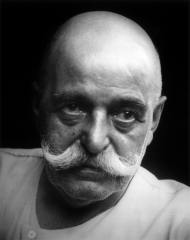
G.I. Gurdjieff
In the middle of a forest a man-eating snake saw a monk coming along a path. He went to meet the monk to ask if it was possible for him to take religious vows.
After listening to him, the monk said, “Yes, but if you take religious vows, you will no longer be able to eat men, or attack them!”
The snake promised to obey his instructions.
So, the monk gave the snake some advice, told him how to pray, and said to him, “In one year I will come this way again, and we’ll see how you are getting on,” and he went on his way.
One year later, the monk came back through the same forest. He saw the snake coming towards him. But the snake was emaciated, and covered in wounds. The monk asked him what had happened.
The snake replied that having kept to his promise of no longer attacking men, these men and children had started to throw stones at him.
“I see!” said the monk. “Yes! yes! I certainly asked you not to attack people, but I didn’t forbid you to hiss!”
I’ve seen this story in several places, but the original source, I believe, is from an excellent book by Solange Claustres, entitled Becoming Conscious with G.I. Gurdjieff, published by Eureka Editions.
For me this story touches, among other things, on what it means to take part in life, to play a role doing what is necessary and appropriate, while remaining inwardly free.
Practicing Patience
Impatience is intimately related to many of the problems of our inner and outer lives. Assuming you agree, how do we learn to be more patient?
The first step is simply to see, sense, and feel just how impatient we actually are, as well as how this impatience produces so much pointless activity and negativity in our lives. Each of us needs to verify this for ourselves. In many cases the awareness itself of our impatience will help us become more patient. But what if it doesn’t? What can we do? Can we practice patience?
Yes, of course, there are many ways to practice patience–if we really wish to. One of the most effective ways comes from the Tibetan Buddhist teacher Tarthang Tulku, who says: “Instead of running after patience, relax and let it come to you. Loosen the tension in your body; open your concentration and allow your emotional energy to flow. Let the warm, soothing energy of patience arise within you and flow through your body easily and freely. This practice is the act of patience.”
During these difficult times of economic and international stress, turmoil, and conflict this is a practice that can pay many dividends.
Though I cannot remember in which book I read the above passage, one of my favorite books by Tarthang Tulku is Openness Mind. And while I couldn’t find the passage there, the book has other insights on the importance of patience. For example, he says there: “When we consciously develop patience, it can become a natural and appropriate response to each new situation; we strengthen ourselves for even more difficult times.”
The question remains, however: do we really wish to be patient, or are we all too ready to succumb to the allure of impatience, to the ubiquitous but erroneous assumption that it will help get things done faster and better?
For more articles and essays, please visit my Harmonious Awakening website.


 Harmonious Awakening