Announcements
Get free breathing and awareness practices, insights, and tips on my Facebook Public Figure Page
Cleaning the Pool: A Miracle of Presence
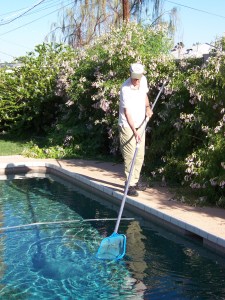
Dennis Cleaning Pool
I awoke this morning to discover that our swimming pool was filled with leaves from last night’s high winds. Though part of me dreaded the cleaning job that lay ahead, another part, more who I am in my essence, welcomed this new situation as an opportunity to go outside in the sunny cool air and work with simple presence. And so I did.
I was joined by Ella, our golden Retriever, who is very near death from cancer. She lay totally relaxed on the moist grass and wagged her tail whenever I spoke to her or gave her any kind of attention. I felt a deep sense of sadness as I looked at her. But thankfulness too that I had (and still have) the opportunity to experience her wonderful presence.
Working quietly scooping leaves from the pool with a skimmer net attached to a 10 foot aluminum pole felt really good: me, here, cold hands, arms and back aching, birds singing, weight supported by earth, immense blue sky, and a never-ending supply of leaves in the pool. What more could I ask for? It was all perfect.
Yes, thoughts arose, though they were only temporary guests in the vast expanse of presence, very much like the leaves in the pool. Eventually, of course, the leaves began to disappear, almost as though by magic. My only job was to scoop them up and toss them over the fence into the alleyway behind our garden, not to count them. And the thoughts, which were incapable of disturbing my tranquility, vanished too.
Suddenly the surface of the pool was shimmering again. As I looked deeper, though, I realized that that many leaves had sunk to the bottom of the pool overnight and that my automatic bottom pool cleaner was not getting the job done. As I looked more closely, I saw that the cleaner was not actually touching the bottom of the pool, almost as though it preferred to remain above the messiness. As I pulled the cleaner up to the surface of the pool and looked even more closely, I noticed that a small brush, undoubtedly blown into the pool by the wind, had lodged into the suction hole at the bottom of the cleaner and was projecting down two or three inches, so that even though the cleaner was flapping its paddles it was never able to touch bottom. A simple fix; just pull the brush out!
It’s often like that, isn’t it? But it’s not always easy. As George Orwell wrote: “To see what is in front of one’s nose needs a constant struggle.”
For me this morning, though, no struggle was needed. Something was wide awake, and that is all that was necessary. As I write these words, imperfect messengers though they be, the wakefulness remains. It’s a miracle; it brings the world to life.
A Remedy for Self-Importance?

Mulla Nasruddin On His Travels
As he was about to sit down, the palace guard quickly came over to him and said: “Sir, that chair is reserved for our guest of honor.”
“I am much more than a mere guest, honorable or not,” the Mulla replied without yet sitting down.
“Well, who are you? Are you a diplomat?” the guard asked.
“No, I am not a diplomat,” the Mulla said. “I am much higher than that.”
“Well, perhaps you’re a minister,” the guard suggested suspiciously.
“Not even close; I’m much higher than that,” the Mulla said.
“Well, the only title higher than that is the title of king,” the guard replied with undisguised impatience. “Are you perhaps the king himself?” he asked with great sarcasm.
“No, I am much higher than that.”
“Are you crazy? In this town, nobody is higher than the king,” the guard said angrily.
“Ah, at last. Now you understand. I am nobody!” the Mulla said as he sat down.
A free rendering by me of one of my favorite Mulla Nasruddin stories.
Some Musings About TV, Books, Meaning, and Freedom
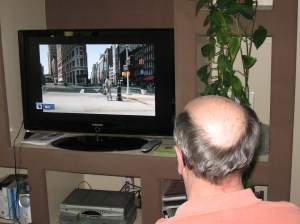
Dennis, Wide Awake, Watching TV
To those who still warn us about the evils of TV, I can only say that TV is not the enemy! Ah, yes, I am well aware of what Marshal McLuhan wrote about TV, especially about how it alters the brain. I was a big proponent of his views for many years. Since then a lot of research has been done. A Manchester University study found, for example, that watching television exercised both sides of the brain, making information easier to understand. The researchers pointed out that the brain assimilates information best through sound and vision, which is why TV has such a powerful influence. Other studies have shown when it comes to young children excessive TV viewing undermines the basic principles of how young children learn—through sensory involvement.
No, TV is not the enemy. The enemy is our own stupidity and laziness in using the TV as a means to pacify our children instead of getting them involved in actively using their bodies, minds, emotions and creative imagination. Passivity is the problem—not TV.
Some will tell us that that reading is better than watching TV. Well, might it not depend on what we read and what we watch? But the issue is deeper than that, of course. Reading abstract words (not ideograms or pictures) from left to right in our books conditions the brain to a certain way of thinking and perceiving. What’s more, think of all the garbage that is published and read today and that fills our minds and the minds of our kids. Think of the emphasis in our schools on memorizing what we read in order to pass tests and earn the respect of our educators. Learning how to read well certainly makes us more functional citizens of today’s world, yet few of our books really help us think, ponder, and explore. Interestingly, very few people complain about reading books, except those books that upset their so-called moral values. Very few people criticize those who sit for long hours on their butts reading, without any real sensory involvement. Don’t get me wrong; I’ve always loved books, especially those that challenge me, that make me think and look and listen and sense in new ways. But to offhandedly say, as many people do, that reading is better than watching TV skirts the real issues involved.
When I was a young boy there were few TVs around, and we didn’t get one till I was about eight or nine. I often listened to radio shows while I did whatever else I did. The shows were based on the various comic book characters, such as Superman, and one could write in (and send 35 cents or whatever it was) to a post office box to get secret decoder rings (to get an idea of what would happen on the show next week) that also had a secret compartment, a magnifying glass, and a tiny pen. For a kid, this was amazing stuff. It excited my imagination. And, of course, the ads (designed for kids) that went with the radio shows were very seductive.
I can remember when we got our first TV how our family and friends circled around it watching news and a football game. There weren’t many viewing choices in those days. And I can remember later on how my mother and I watched TV together at night before bed, occasionally making comments, until my mother fell asleep. It was always a funny moment when I would wake up my mom and tell her that she had fallen asleep, to which she invariably said: “No, I was watching.” A very touching moment for both of us, a moment that brought us closer by virtue of what we both knew to be true.
What should we do with our so-called free time, with or without others? Should we always be productive? Is there room for imagination and dreaming, as well as inner and outer work on ourselves? Are we whole human beings overflowing with the sometimes messy flow of the life force, or do we envision ourselves as though we were a literary (left to right) character in a book on the well-trodden path to some goal in the future? Our conditioning is so deep and unconscious that we don’t even realize how much reading from one word to the next, one sentence to the next (especially the kinds of sentences that are short and predigested for easy consumption) one page to the next, and so on shapes the way we look at ourselves and the world. And, for those who read a lot of fiction, it is perhaps even more pernicious, since so much of it is based on what is going to happen in the end. When you read great writers like Dostoevsky and Tolstoy, however, you are plunged into a multi-sensorial world in which linear time ceases to be as important as what is happening right now. One can have these experiences with Henry Miller and other great writers as well. Each of the pages of such writers are filled to overflowing with the mystery–the big questions–of life itself.
I raise these questions and issues because I believe that the dilema that many of us face is a lack of real meaning in our lives, and the resulting unconscious tendency toward identification with and addiction to whatever we do or experience, not just to alcohol, drugs, sex, TV, books, radio, and so on. In his book America Anonymous, my son, Benoit Denizet-Lewis, writes that “as we obsessively search for new and innovative ways to escape the reality of the present moment and make ourselves feel ‘better,’ we’ve created a schizophrenic culture where nothing is ever enough, where stillness is equated with boredom, and where we need increasingly intense experiences just to feel alive.”
We attempt to escape the present moment in many ways. That needs to be fully seen and felt, no matter what form it takes. At the same time, though, we have to remember that there is always something going on now, and it is our relationship to now (whether it includes TV, sex, radio, discussions, having a drink, thinking, dreaming, bitching, laughing, meditating, traveling to exotic places, posting on Facebook, and so on) that determines whether or not we become identified with it or addicted to it. One could accurately say that each of us is addicted to our self-image, and the habitual thoughts, beliefs, and emotions that support it, yet that is taken as somehow being normal, even though this addiction probably ruins as many relationships and lives as alcoholism, drugs, and the other text-book addictions, although in more subtle ways.
This question is enormous. And G. I. Gurdjieff was obviously correct when he says that one cannot change one thing in oneself without knowing the whole “machine.” Throwing out TVs (as some of my friends did back in the 60s and 70s) or telling kids they cannot watch TV will not help with identification and addiction. There is always something else to become identified with or addicted to. Get rid of one and another one pops up. That is a law of unconscious living. We have to see, feel, and sense this law in action if we are to discover real freedom.
Copyright 2009-2013 by Dennis Lewis
Stress, Education, and Breathing
We live at a time in which excessive stress is so deeply entrenched in our various institutions–including education, media, government, and business–and so widespread that many of us take it as being a natural part of living.

PET Image of the human brain showing energy consumption
Research has shown, however, that excessive chronic stress can have a debilitating influence on our health and well-being. Those who have observed themselves in any depth knows that chronic stress has a negative influence not just on the human body but also on the brain–especially on short-term memory and on the ability to concentrate effectively. Though many interpret this influence on the brain as purely “psychological,” one that they can somehow control if they just try harder, recent evidence shows that the hormones associated with even minor stress can actually inhibit the prefrontal cortex of the brain, which is involved in concentration and memory. In lab rats, for example, researchers have found that severe long-term stress can cause irreversible brain damage. The influence of stress on memory and concentration is an important consideration in our greatly over-stressed society. Though stress is a natural and necessary part of living, indeed even a motivating factor for many people, more and more of us experience excessive levels of chronic, often unidentified, stress and tension in our lives, and this in turn reduces our ability to concentrate and learn.
Educating Our Children to Deal With Stress
Knowing what we do about the ill effects of chronic stress, it is important to explore ways to reduce stress not only in our own personal lives, but also in the ways we raise and educate our children. Learning, especially learning from our so-called mistakes (which, of course, are frowned upon by many teachers), can be an enjoyable process that opens us to the world in and around us. When it is enjoyable, our brain functions in an optimal way and we seem to perceive and learn things more quickly and deeply. For many students, however, especially in elementary and high school where passing standardized tests is often the main objective, learning, even learning through physical education and sports, has ceased to be enjoyable and has instead become one more reason to get “stressed out.” “No pain, no gain” is the mantra of many elementary and high school gym teachers. In this regard, you might be interested in reading an article (first published in Somatics Magazine) by me entitled Physical Fitness—A New Approach, which recounts one of my own unsettling experiences in a high school gym class.
Given the increasing levels of stress in today’s world, and the many ways in which this stress is promoted through instant worldwide communication, part of our education should include teaching young people how to deal with stress when it arises in them. Sports and athletic programs aren’t much help here, since they most often promote competition and “winning” at all costs and very often at the expense of learning and enjoyment. They thus greatly contribute to the growing levels of stress in our children. One need only visit a little league baseball game or a high-school football game to see what happens to the kids, parents, and coaches in this environment. Winning and losing are indeed facts of life, and it is important to do the best we can in whatever we do, but it is how we deal with winning and losing, and our often unconscious attitudes toward them, that play an important role in determining our physical, emotional, and mental health.
Short of a radical transformation of our societal values, one of the most powerful methods of dealing with stress, which should be taught in schools worldwide, is deep relaxation through body awareness and natural breathing (what I sometimes refer to as “authentic breathing”). Body awareness through disciplines such as tai chi, qigong, and yoga, along with learning how to breathe in a natural, balanced way, would not only help improve the overall physical, emotional, and mental health of our children, but would also give them early on some of the basic tools they need for learning how to relax and function effectively in the midst of stressful situations.
Unfortunately, few teachers–in fact, few adults in general–are themselves able to relax deeply and breathe fully and naturally. The admonition to “take a deep breath and relax” that we hear so often from our teachers, politicians, friends, and parents not only rings hollow in most cases, but it also often results in fast shallow breathing, which only increases our already high levels of tension, anxiety, and stress. To breathe well in a state of dynamic relaxation, to learn how to experience the fullness of the “breath of life” that connects us all at a fundamental level, is to provide the living foundation for physical, emotional, mental, and spiritual health.
Copyright 2009 by Dennis Lewis
The Elephant & The Student
A student was meditating with his teacher in India as he did every morning. It was a meditation about God, about the fact that everything at the deepest level is God, and about the fact that God in essence is love. During the session the student believed that he reached a very deep level of God realization in himself, and felt that he understood the meaning of his teacher’s words: “You must learn to listen to God.”

Caparisoned elephants during Sree Poornathrayesa temple festival, Thrippunithura, Kerala, South India.
As you can imagine, the meeting between the student and the elephant was not very pleasant for the student. The elephant’s trunk swept the student roughly off the path and into a huge thorn bush. The student, realizing not only that he was bleeding profusely from his fall but that he had also broken his arm, got up and quickly went to the town healer.
A few days later, the student returned to his teacher with his arm in a cast and numerous bandages over his body and explained in great detail what had happened. Then, in an almost accusatory voice the student said: “You told me everything was God and that God was love. How could this possibly happen to me?”
The teacher, nodding his head, said “yes, it’s true that everything is God. But didn’t I also tell you that you had to listen to God?”
“Yes,” said the student, “I was listening to God deep in my own heart.”
“That’s all well and good,” the teacher responded. “But didn’t you realize that the elephant driver was God too? He told you to get out of the way.”
Retold by Dennis Lewis from an ancient Indian story.
These Passing Years

Dennis Lewis in 2005 in his San Francisco garden
For my 65th birthday celebration, which took place in 2005, I wrote a poem about my life and presented it, along with some of my favorite poems, to those who gathered in Dasha’s and my former home in San Francisco. My good friend David Hykes, award-winning composer, singer, harmonic chant pioneer, and meditation teacher, was there with us and sang before, during, and after the readings. David’s singing was amazingly beautiful and especially relevant to the poems I read. Click here to learn more about the evening and listen to the celebration.Some of my friends who took part in the celebration, as well as some who weren’t able to take part, have asked me for the written version of the poem. Though I have been slow in responding (and I am sorry for that), I am finally including it here for those friends, as well as for anyone else who might be interested, for whatever reasons, in learning more about my life.
To understand the beginning of this poem, it may be helpful to know that my father, Cappy Lewis, was a solo trumpet player with Woody Herman and many other bands, and that my mother and I sometimes traveled with him for his gigs until I was about five years old.
These Passing Years
Delicious impressions of
a four-year old boy waking up alone
to the mysterious smells
of the warm, perfumed wind
blowing gently through the shadows
of dancing flowers just outside
the partially open window and to
the comforting beats of big-band jazz–
and waiting in anticipation
for his mother and father
to return to the motel room
from the jazz club just across
this mysterious garden of flowers.
I knew the very next day
that it was a small garden,
and yet, somehow,
it seemed infinite that evening,
impossible to traverse with feet or senses.
Perhaps my sense of these passing years began here,
but I do not really know.
There’s much more to say, of course,
but does anyone really know the whole story?
Delicious impressions of
the many books I’ve held in my hands
through these passing years,
beginning perhaps with Uncle Wiggly,
who wiggled himself into and out of
frightening situations
with ingenious regularity,
and ending perhaps
with the last revealing page
of the as yet unfinished
manuscript of my life.
Each book, more often than not,
throwing light on the shadow play
of my hopes and fears,
helping my thoughts break their bonds,
and opening me
to new perceptions
of myself and the world.
There’s much more to say, of course,
but does anyone really know the whole story?
Delicious impressions of
my relentless urge to merge with
the unfathomable smiles, bodies, and souls
Of the wondrous women I’ve held in my arms
through these passing years,
a special few, not taken
by their own beauty and power,
helping me to understand
that the heart of the matter
is only revealed
in the silent depths
of an awakened heart.
There’s much more to say, of course,
but does anyone really know the whole story?
Delicious impressions of
unconditional love while looking
into the loving eyes of my son
through these passing years,
and gradually learning
how to look at myself afresh
through the versicolored lens
of his own expansive heart.
There’s much more to say, of course,
but does anyone really know the whole story?
Delicious impressions of
exploring who I am
and why I am here
through these passing years–
Gurdjieff, Advaita, The Tao, Headlessness–
all the wonderful teachers and teachings
compassionately guiding me toward
what they had discovered to be “the light,”
and sometimes, due to its sheer brilliance,
blinding me from the inevitability
of my own real path–
the path actually taken.
There’s much more to say, of course,
but does anyone really know the whole story?
Delicious impressions of
turning pages, smiling faces,
sexual passions and diversions,
observations and remembering,
working, playing, and enduring,
thinking, feeling, loving, fearing,
touching, tasting, and regaling,
searching, writing, teaching, learning,
smelling, singing, always exploring
the ever-expanding edges of my own desires,
creating new territories and new maps
for inner and outer travel and discovery,
and quietly, oh so quietly,
being called from some unknown place,
to simple appreciation for the great gifts
I have received through these passing years.
There’s much more to say, of course,
but does anyone really know the whole story?
Delicious impressions of
The law of attraction at work,
Of how my being has attracted my life
through these passing years.
My many so-called problems,
whether of body, mind or spirit,
often glimpsed now for what they are—
low-frequency, fragmentary energies
called into my life and
given too much attention
through a basic misunderstanding of
who I really am and what I really want.
There’s much more to say, of course,
but does anyone really know the whole story?
Delicious impressions of
the underlying oneness of the
magical dualities of time and space.
No matter what my thoughts tell me
about my experiences of this life
through these passing years,
about how beautiful or ugly,
how pleasurable or painful,
or how real or illusory
they were or are
I have faith now,
a deep, steady feeling,
that it is all good; it is all God;
it is all part of the lawful
unfolding and embrace of Great Being,
the agony and ecstasy of communion,
of learning how to be here consciously
at both the center and the periphery
of the infinitely creative
spaciousness and silence of what
is sometimes called The Source,
and which now I am sometimes blessed
to recognize as who we really are.
There’s much more to say, of course,
but does anyone really know the whole story?
And now, tonight, delicious impressions of
this spaciousness, this silence,
resonating with the uplifting vibrations
of you my friends (and of you my Love),
breathing, laughing, listening, walking,
sitting, feeling, questioning, talking,
all of us celebrating together
the greatest miracle of all:
the mysterious Nowness of these passing years,
the miraculous Loving Presence that
calls us home again and again and again.
There’s much more to say, of course,
but does anyone really know the whole story?
Copyright 2005-2009 by Dennis Lewis
On the Shooting Range
Richard, a friend of mine who also takes part in our Sunday night Harmonious Awakening meetings in Scottsdale, invited me a couple of days ago to go to the outdoor shooting range with him. Now I hadn’t picked up a gun in more than 50 years (when I was a kid I had a 22 and a shotgun), so, I thought it might not only be enjoyable but also educational, which it certainly turned out to be.
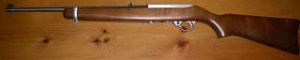
Ruger 10/22
Shooting the 10/22 I was able to be very still inside and found that squeezing the trigger slowly during the natural pause at the end of the exhalation brought me the best results. At that moment I was so inwardly relaxed and outwardly still that most of my shots with the 22 hit the bull’s eye or were very close to it.
I was not so fortunate with the 45 caliber handgun or an old single-shot rifle that he had that was apparently extremely accurate. Richard had warned me that both would have a big kick, and, of course, this thought made the inner silence that I had come to with the 10/22 a bit more difficult to discover anew. Nonetheless, I was able to become relatively quiet and my breath remained slow and soft, but my shots came nowhere near the bull’s eye.
I am now considering getting a 10/22 for further experimentation along the lines of “Zen in the Art of Target Shooting.” I remember how much fun I had as a kid shooting targets in the woods with my 22. I have the feeling that part of the fun was the deep sense of stillness and concentration that I had while shooting.
Awakening & The Struggle With Lying
Some people say that no struggle is necessary in order to awaken. One especially hears this from the new and fast-growing crop of non-dual Zen and Advaita teachers, some of whom even offer Satsangs on the Internet.
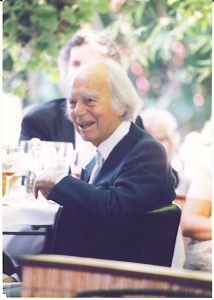
Jean Klein
The process of awakening involves far more than the mind, with all of its beautiful thoughts about non-duality; it also involves the emotions and body. We have to see, as Jean Klein frequently reminded us, that we are not our thoughts, emotions, and sensations. To see this, however, we need to realize that we are constantly lying to ourselves, both consciously and unconsciously. Jean helped us in this process, for example, not just with his illuminating and loving Satsangs, and with self-inquiry, but also with other meditative approaches, including a powerful form of esoteric yoga that helped us in an intimate way to experience our bodies more as energy and emptiness than as form and substance. (I will write more about work with the body in future blogs.)
Here is a brief passage from a talk I gave some years ago that goes further into the question of lying:
“The struggle that we need to undertake is the struggle to see the way in which I constantly lie to myself. It is the struggle to be inwardly sincere. It is this seeing, a process that also requires the support of my body and feelings … that can free me from my habitual preoccupations, expectations, and beliefs—those powerful psychological states that keep me from experiencing myself and the world in the fullness of the present moment. But as anyone who has tried knows, the effort to be inwardly sincere brings with it suffering, real suffering, the immediate, painful experience of the many ways in which I cut myself off from the truth. This experience, as difficult as it is, also brings with it a great sense of freedom and joy, a sense of returning home from exile.” (From Awakening to the Miracle of Ordinary Life)
Copyright 2009 by Dennis Lewis
The Independence of Solitude
Ralph Waldo Emerson wrote: “It is easy in the world to live after the world’s opinion; it is easy in solitude to live after our own; but the great man is he who in the midst of the crowd keeps with perfect sweetness the independence of solitude.”
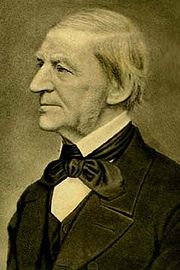
Ralph Waldo Emerson
To do so, of course, one cannot be a “conformist.” To be a conformist, “to live after the world’s opinion,” is to be just another cog in society’s complex machinery–dead to the human spirit within. When we look around today we see such death at every corner. Instead of a spirit of discovery and truth, we stumble over the dead carcasses of social, political, and spiritual correctness. Instead of the willingness to contradict ourselves and our beliefs when we are faced with new insights and discoveries, we most often find ourselves either burying our new insights deep within our solitude so as to remain in harmony with whatever “crowd” we identify with, or grafting our insights for public consumption onto our old memories and beliefs in such a way that they lose all power to help us or anyone else think, feel, and sense the truth.
It does not matter whether the “world” Emerson speaks of is the larger world composed of diverse nations filled with people who call themselves “patriots” or the smaller world of diverse spiritual groups filled with people who call themselves “followers.” There is, in my estimation, little intrinsic difference between patriots and followers; both are examples of what Eric Hoffer called The True Believer. In both cases people take on the larger, more-comfortable perspective of a nation or group or teaching without realizing that in so doing they may well have cut themselves off from the less-comfortable perspective of truth itself.
When I was studying at the University of Wisconsin (back in the late 1950s), I joined a fraternity, where I lived, studied, and partied for more than a year. One day, in my solitude, I reached a decision to go to a political demonstration I had heard about (my first real flicker of political awareness). When I brought this decision to the larger world of the fraternity and suggested that perhaps others should go too, the vice president of the fraternity told me that he didn’t approve of my going–that it was against the ideals and rules of the fraternity–and that if I did go I should definitely not wear my fraternity pin (or ring, I don’t remember). I got very angry and told him that I didn’t have one (which was true and probably why I don’t remember) and that even if I did have one I would definitely wear it if I wanted to. He then told me that if I went I would be kicked out of the fraternity. I resigned from the fraternity on the spot, found a new place to live, and took part in the demonstration, which I felt in my heart of hearts was a true expression of who I was at that time.
Was I a “great man” in Emerson’s words? Absolutely not! Instead of keeping “with perfect sweetness the independence of solitude” “in the midst of the crowd,” I was a good example of an angry unconscious young man, without much “sweetness.” And yet, in spite of this, something of the truth awakened in me and began to manifest more and more often–the realization that, as difficult and revealing as it would be, it was necessary for me to attempt to live my own life as consciously as possible unencumbered by the opinions of others, no matter where that led and what difficulties it brought.
Since those early years, I have been involved for many years with teachings and groups (concerned with awakening) that helped in ways that I will not discuss in detail here. I am thankful for what I received through these teachings, especially from my teachers who showed how it is possible “in the midst of the crowd” to keep “with perfect sweetness the independence of solitude.” This is meditation in action–the natural and spontaneous state of those who have awakened to who they really are.
Copyright 2009 by Dennis Lewis
Letting Go of Unnecessary Tension & What No Longer Serves Us
For many years I owned, with a partner, a public relations firm that specialized in high-tech companies like Sun Microsystems, Oracle Corporation, and many other established and start-up firms. As we grew from two people to more than 40 people over an eight year or so span (until I left the company two years after we sold it to a large UK firm), and became one of the top technology agencies in the country, I experienced almost every imaginable business tension and stress possible, which, from my perspective today, contributed to some issues with my health (some immediate and some that arose later).

The Tower of Babel by Pieter Brueghel the Elder (1563)
To be sure, some of us take great pride in calling our unnecessary tension “intensity,” which the Webster dictionary defines as an “extreme degree of strength, energy, or feeling,” but I know from my own life that real strength and feeling do not require unnecessary tension. Quite the contrary, they require dynamic relaxation–a harmonious interplay of our own inner energies, of yin and yang, of relaxation and tension, of exhalation and inhalation.
As I said in my audio program Natural Breathing: “There are many obvious reasons for learning how to relax unnecessary tension, but one that is often overlooked is that such relaxation frees the brain to notice and respond to a broader, more-subtle spectrum of data and impressions, of what is actually happening at any moment. It is this increase in ‘perceptual freedom’ that can be one of our major contributions to promoting vitality and good health in ourselves. Perceptual freedom allows the brain and other systems of the body to make maximum use of their powers in discerning problems and responding appropriately. The hormones, enzymes, endorphins, T-cells, and neuropeptides being produced by the brain and body change dramatically in relation to our ability to perceive in new ways. To be able to perceive in new ways means that our energies are not locked into old patterns, but are free to respond to the actual needs and possibilities of the moment.
Anyone who has studied martial arts, tai chi, dance, and so on knows that the body is capable of remarkable intelligence, sensitivity, and action when we are able to rid ourselves of unnecessary tension. It is the ability to be inwardly sensitive in the midst of action, to be relaxed and free enough to experience subtle variations in our sensations and feelings, which lies at the heart of our health and well-being.”
And further, in my essay Relaxation & Letting Go, I wrote: “The great spiritual traditions … teach that relaxation–including the special, inner action called ‘letting go’–lies at the heart of inner work and awakening. The principle is a simple one, at least on the surface: unnecessary physical or nervous tension clouds our perceptive faculties. It cuts us off from the light of consciousness and from the direct inner and outer impressions of reality it can bring. Deep, conscious relaxation is what can ‘open’ us in a harmonious way–body, mind, and feelings–to new levels and frequencies of perception. It can help us reclaim the miraculous sense of aliveness and awakeness that is our birthright.”
In the same essay, I explored the need for relaxation and “letting go” not just in the body but also in the mind and heart. The excess tension in our body often simply reflects (and supports) the deep mental and emotional conflicts that we experience. And these conflicts are often the result of our inability to “let go” of the thoughts, beliefs, assumptions and expectations that no longer serve us.
No one, for example, really knows exactly what is going to happen to our economy over the coming years–with or without Obama’s recovery legislation. Yet we live and speak and act as if we knew–and this belief that we know makes any real exchange with others mostly impossible. The fact is, we seldom listen impartially, with a genuine interest in learning, either to ourselves or others (which I discuss further in my essay The Lost Art of Listening).
If you look and listen honestly within right now you will quickly see at least one thing–perhaps an idea or assumption or expectation or belief or frown or tension–that no longer serves you, one thing that captures your attention, dulls your perception, and buffers you from the unknown. Can you let it go? Can you drop it right now? And if not now, when?
See also The Breath of Life.
Copyright 2009 by Dennis Lewis


 Harmonious Awakening