Announcements
Get free breathing and awareness practices, insights, and tips on my Facebook Public Figure Page
The Inner Pause

Dennis Lewis
Can you just pause inwardly for a moment in the midst of all this and experience the miraculous nowness, the silence and spaciousness, that is always here, wherever you are, just waiting for your attention? If not, that’s okay too. The inner pause, the inner stop, is not just one more technique, one more thing to do; it is a portal into the mystery of who you are.
Getting in Touch with Your Gut Brain through Belly Breathing
Dennis Lewis
For many hundreds of years the Taoists have spoken of the importance of the “belly brain,” or “little brain,” in health, healing, and self-transformation. It may have taken a while, but according to an article by Sandra Blakeslee in the Medical Science section of the New York Times (January 22, 1996), western scientists finally “discovered” that the gut does indeed have its own brain, referred to as the enteric nervous system, which “is located in sheaths of tissue lining the esophagus, stomach, small intestine, and colon. Considered a single entity, it is a network of neurons, neurotransmitters and proteins that zap messages between neurons, support cells like those found in the brain proper and a complex circuitry that enables it to act independently, learn, remember, and, as the saying goes, produce gut feelings.”
The Taoists believe that the gut brain processes not just food but also emotions and other experiences, and that paying attention to this brain, learning to sense it and listen to it, can have an enormous beneficial impact on our lives. And I have certainly found this to be the case.
Those of us who are able to sense our bodies in an impartial way know that a lot of our fear, anger, anxiety, and other negative emotions are stored or at least reflected in the gut. And we know that the gut brain is intimately involved in communication between mind and body. Though it’s important eventually to be able to sense our gut, our belly, in the midst of action and stress, it’s helpful to start by practicing in quiet circumstances.

Getting in Touch with the Gut Brain
I’ve been writing about and teaching this powerful work with the gut since 1994, both through Chi Nei Tsang (internal organ chi massage) and through my work with natural breathing. You can work with a more-complete form of this practice by visiting my belly breathing blog of February 20th, 2009. You can also find much more material in my books.
Next time you have a “gut feeling” about something, just tune in to your belly and how it moves as you breathe. This simple act of attention will reveal far more about your situation than you might imagine.
Copyright 2010 by Dennis Lewis
Inattention

Dennis Lewis
We may believe that our inattention is strictly our own business, but our inattention, the fact that we are so easily distracted, has ramifications that spread well beyond ourselves. Inattention often causes problems, wasted time, and even injury and death not only for the inattentive person but also for numerous others, sometimes not only those close to us but also those we don’t know. Chronic inattention (and the concomitant lack of concern for others that it often demonstrates) is fast becoming one of the chief features of modern life.
For anyone who wishes to live a more human, intelligent, conscious, or spiritual life, the study of attention is crucial. Our attention is what connects us with the world in and around us. Without it, we are simply sleep walkers, experiencing little more than tiny fragments of ourselves, and out of touch with the energies and rhythms of wholeness and relationship.
To go further into this important subject and learn how to begin to study your attention in the midst of action, read my essay on this blog entitled The Alchemy of Consciousness.
The Primal Scream, by Arthur Janov

The Primal Scream
According to Arthur Janov in his recent book, The Primal Scream, “neurosis is a disease of the feeling. At its core is the suppression of feeling and its transmutation into a wide range of neurolic behavior.”
In a culture whose educational goals are directed toward the development of the mind or, more precisely, the technological use of the mind, this is not a surprising diagnosis. Suppression of feeling is obviously a price we pay for viewing rationality apart from the energies of the whole man. But Janov does not “console” himself with the rationalization that we live in an age of neurosis . . .” He suggests that “there is something beyond improved functioning in socially acceptable ways, something beyond symptomatic relief . . . there is a state of being quite different from that which we have conceived . . .”
Janov believes that neurosis begins when a child is not loved and accepted for what he is. Not being able to be himself, not being able to feel his own real needs without a painful sense of contradiction, he shuts himself off from his feelings and begins to “want” those things which he believes will bring his parents’ love. But the denied needs do not disappear. The pressure generated by their lack of fulfillment accumulates in his organism, upsetling its natural balance, and causing behavior which becomes increasingly “symbolic.” This symbolic behavior eventually shields the neurotic from his own inner pain, and supports him in his “hope” that his substitute wants and needs will somehow be satisfied. He does not realize that his struggle for satisfaction is essentially historical, that it derives its energy from the pains of the past. As a result, the neurotic’s life is full of the tensions that arise from his constantly defending himself against himself. As Janov points out, “people go crazy to keep from feeling their truth.”
Janov believes that the entire process of neurosis and its cure can be understood in relation to energy transformations. “We know by the law of conservation of energy that energy cannot be destroyed; it can only be transformed. I view the original Primal Feelings as essentially neuro-chemical energy which is transformed into kinetic or mechanical energy impelling constant physical motion or internal pressure. The aim of Primal Therapy is to change this transformed energy back into its original state, so that there will no longer be an inner force pushing the person toward compulsive action.”
How is this change accomplished? It is here that Janov makes his most radical break with traditional forms of therapy. He claims that it is only by a “forceful upheaval” of the entire defensive system that the neurotic can become real. For unless this system is completely destroyed it wiil continue to “grind up and absorb” whatever truth may reach it, whether through explanations, analysis, insights or any other means. An obvious truth, yet perhaps ineffectual in itself because it is the “unreal system” which hears it and pretends to agree. The neurotic, therefore, cannot cure himself.
According to Janov, since pain caused the neurotic split in the first place, it is only through intentionally experiencing this denied pain that the kinetic energy of neurosis can be changed back to its neuro-chemical form—thereby depriving the defensive system of its source of energy, and freeing a man from his slavery to the past. To facilitate this process Janov believes that the therapist must help the patient lose control, the defensive control which keeps the real self suppressed. The therapist attempts to keep the patient from dissipating his energy (draining off his pain) through “symbolic behavior.” In the midst of a buildup of internal pressure the patient is encouraged lo “sink into” any early situation that evokes strong feelings and to experience that situation in its entirety. If there is any resistance to this in the form of talking “about” the past, instead of living it, the patient is encouraged to call out to his mother or father (or others who might be important in this situation) as though he were speaking directly to them, and to try to express what he really feels.
Sometimes the therapist has to work directly with the patient’s breathing. “Because neurotic breathing is designed to clamp down against the pain, forcing the Primal patient to breathe deeply often helps lift the lid of repression. The result is the emission of explosive force, something which has been diffused throughout his body, in the form of high blood pressure, elevated temperature, shaky hands, or whatever . . .”
When the Primal Scream occurs, it “is at once a scream from the pain and a liberating event where the person’s defense system is dramatically opened up. It results from the pressure of holding ihe real self back, possibly for decades.” Janov makes it clear, however, that it is not the scream which is curative, but the pain the patient experiences as a result of being “wide open to his truth.”
By the end of Primal Therapy, which consists of an intensive three-week period, along with three months or more of group therapy, the patient has undergone many such experiences through which he is brought into contact with his own real feelings. The post-Primal patient, says Janov, is a “new kind of human being.” He is able to live fully in the present, without fear, without moods, without depressions, and without unnecessary tension.
Whether or not we accept this claim, Janov’s work with neurosis makes clearer the importance of the feelings for human growth to take place. “The activities which will make basic changes in individuals must flow from their feelings. The flow must occur from the inside out.” Clearly, this is an important idea for a culture which believes that meaningful human change can be manipulated from without, lacking the active participation of man’s own will. The latest experiments in altering behavior through the use of electrodes implanted in the brain represents this position in extreme. Janov recognizes that it is the whole of a man’s being which is at stake, not only his behavior. The neurotic must be willing to undergo a new dimension of pain in the movement from unreality to reality, with full acceptance of what he discovers in himself.
It is just here that Janov’s work with neurosis seems to be changing direction. In his latest book, The Anatomy of Menial Illness, he reports that many of his patients have relived their birth, that is, they have experienced “birth Primals.” Since all life processes follow natural rhythms, it is important, as Janov states, for a child to be born in his own rhythm. To have a difficult birth, to enter the world already out of rhythm with himself, establishes in the child unconscious attitudes towards life, a matrix of experience that reverberates through the child’s whole being.
Janov has equipped his office with various devices to simulate the birth process, thereby producing sensations which can reawaken the buried memory circuits that plague the neurotic. He also suggests the possibility of a “Primal Machine for refractory cases”; he has found that primals can be induced by means of a strobe light pulsating at specific frequencies.
Whatever the importance of Janov’s latest discoveries, the stress he places on them seems to diminish the call to wholeness that one feels in The Primal Scream. One cannot help but be moved by this call. But the acceptance of the whole of oneself is an enormous undertaking for any man, neurotic or normal. Surely all of us have a scream waiting beneath the facade of our “reality”—the universal scream of mortality and incomprehension, of which the sorrows of parental conditioning are but one expression. But whom can we trust to bring this scream forward?
I wrote this review of The Primal Scream with a lot of help from the Material for Thought writing team, in 1971/72. Reading it again recently, it became clear to me that a lot of the material in this book is as relevant today as it was when it was first written.
To fully understand what this review meant to me, personally, it’s helpful to realize that, at least initially, I really didn’t want to write it. In looking for books to review for Material for Thought I had stumbled across the book in a bookstore, briefly paged through it, and decided it wasn’t worthy. I told no one.
Some weeks later, Lord John Pentland, who had been put in charge of the Gurdjieff Work in America by Gurdjieff himself shortly before his death, came to San Francisco, came into the writing team on our Sunday workday (it was his team), handed me The Primal Scream, and asked me to review it. I then told him I didn’t think it was a worthy book for us, but he insisted.
When I first began the review I had no idea what I was getting into. The way we worked on the team every Sunday was to work on writing the review and then read what we had written to the others on the team. There was usually a lot of feedback, not always easy to take but always given to one another in a respectful way, which generally helped each of us broaden our perspective on what we had written. When Lord Pentland came to town, we would each read our reviews out loud in his presence and he would make whatever comments he felt it necessary to make.
When I first read the review in Lord Pentland’s presence, he made it clear that I had to begin again. He said that I had not really faced my feelings in the review. And so it went, month after month. I would write and work with the team, he would come to town, I would read the review in his presence, and he would tell me that I hadn’t really faced my own feelings, and I would have to begin again. I felt like Milarepa (without the magical or spiritual powers) being told by Marpa to continually tear down, because of some imperfection in his work, the stone structure that Marpa had told him to build on a high rocky ridge. In my case, it had nothing to do with the writing itself, but rather with my inability to face my real feelings about this book and, more importantly, about myself. Each time Lord Pentland told me to begin again, he would give me a new thought or question to consider, which was an enormous help.
After about a year of beginning again and again, and actually beginning to learn to confront my real feelings, which was quite obviously no easy task for me at that time of my life, Lord Pentland came to San Francisco, listened to me read my review, and then remained silent for at least five minutes. Finally, he simply nodded his head yes and said, “Good. We’ll begin the next issue of Material for Thought with Dennis’ review.” Tears came into my eyes, as they do right now in recalling this moment, and I realized how important reading and reviewing this book was for me in relation to feeling my truth. How did Lord Pentland know? It doesn’t matter! He knew. He is no longer on this planet, but he was and still is my teacher.
Dennis Lewis
All subscriptions are free!
The podcasts so far are from 90 seconds to five minutes or so, and are designed to “help us see and go beyond the boundaries of the conditioned mind–the habitual constellation of thoughts, emotions, sensations, beliefs, and judgments that each of us calls ‘myself’–and to help open us to the vast breadth of the life force as it manifests through us at this very moment.” The podcasts include parables, stories, guided meditations, experiments in presence, breathing practices, musings, and much more. Future podcasts will probably not go over 10 minutes or so.
Though I’ve published numerous written materials in the form of books, articles, and essays, it’s also great to hear the human voice (including one’s own voice), which can in just a few seconds often convey more than thousands of written words can.
I hope you enjoy what I offer here, and I welcome your feedback.
“Who are You?”: Mullah Nasruddin in Action

Mullah Nasruddin
As he was about to sit down, the palace guard quickly came over to him and said: “That chair is reserved for our guest of honor.”
“I am much more than a mere guest,” he replied.
“Well, who are you? Are you a diplomat?” the guard asked.
“No, I am not a diplomat,” the Mullah said. “I am far more than that.”
“Well, perhaps you’re a minister,” the guard suggested suspiciously.
“Not even close; I’m much higher than that,” the Mullah said.
“Well, the only title higher than that is the King,” the guard replied with undisguised impatience. “Are you perhaps the king himself?” he asked with great sarcasm.
“No, I am higher than that.”
“Are you crazy? In this town, nobody is higher than the king,” the guard said angrily.
“Ah, at last. Now you understand. I am nobody!” the Mullah said.
My retelling of a classic story featuring Mullah Nasruddin
Being Challenged by Real Questions

Dennis Lewis
So many people are so in awe of their teachers or guides or so happy to receive attention from them that they are afraid to dig deeper even though they know they don’t understand what is being said, or imagine that they understand and so explore no deeper, or don’t really care about the question they asked in the first place. In such cases the real question seldom gets exposed.
Many years ago I had a young student in the Gurdjieff Work who, during the group’s lunchtime exchange on Saturdays, never took the first response I made to her questions as final. Though this was at first irritating to me, I quickly realized that her questions were so vital, honest, and spontaneous, and the way in which she pushed me, respectfully, to go deeper into my own understanding (or to see that I didn’t really understand at all), that they helped both me and the entire group come alive in listening.
In genuine spiritual exchanges a real question is the transforming agent, that which helps open us to see and welcome truth, but only if it’s a real question, a question that arises from (and reaches) beneath the mask of our self-image– whether the mask is frowning or smiling or simply neutral.
Copyright 2010, by Dennis Lewis
An Overview of My Work with Breathing: From an Interview first Published in “The Empty Vessel Magazine”
Dennis Lewis
Dennis Lewis: My work, including natural breathing, qigong, tai chi, and meditation, is oriented toward helping people discover a sense of their own real wholeness. It is based on the fact that most of us lose ourselves constantly in one or another side of ourselves–in our thoughts, emotions, sensations, and so on. As a result, we live fragmented, dishonest, and disharmonious lives. And while we might agree intellectually that this is true, many of us are not convinced enough to actually undertake the demanding work of self-awareness and self-transformation, a work that begins with learning how to sense and observe ourselves sincerely, to listen impartially to ourselves in action. Since our breathing both reflects and conditions the various sides of ourselves, a vital part of this process involves work with breath.
Unfortunately, most of us take our breathing for granted. The great Taoist sage Chuang Tzu says that most of us breathe from our throats, and that real human beings breathe from their heels. One might ask here: are we real human beings? Are we exploring what it means to be truly human? If our breathing takes place mainly in the throat or the upper chest, where it does for most of us, then we can do all the qigong, yoga, and other spiritual exercises we desire but we will never experience a real sense of human wholeness.
A lot of your work is with emotional clearing, cleansing or balancing using breath work, which is something that a lot of people probably don’t connect together.
That’s true. Basically, the first step is to be present to the state that I am actually in. The foundation of my work with breathing has to do with learning how to follow the breath without any interference whatsoever. Why do we need to follow the breath without interference? Well, as Chuang Tzu says, “All things that have consciousness depend upon breath. But if they do not get their fill of breath, it is not the fault of Heaven. Heaven opens up the passages and supplies them day and night without stop. But man on the contrary blocks up the holes.” (Chuang Tzu, Basic Writings, Burton Watson [New York, Columbia University Press, 1964], p. 74) Much of what we do in our lives, and even in our work with breathing, simply “blocks up” our inner breathing spaces. In learning to follow our breath, we not only begin to observe and sense the narrow self-image that ruins so much in our lives, but we also discover a deeper power of awareness that relates to our real human potentiality.
What is it in us that can follow our breath?
What we’re talking about here is the unknown. We can call it the witness, God, the Absolute, higher mind, or whatever we want, but, in general, we do not experience it. We’re looking to get in touch with the whole of ourselves, which is mostly unknown. But my emotions, especially my so-called negative emotions, very often narrow my awareness to a very tiny side of myself. For example, anxiety, anger, and fear put me into a very hyper vigilant, fight-or-flight type of state, a state that undermines both my health and my sense of wholeness. I need to observe this process in action. When I learn to follow the breath, I become convinced of what my state really is. By seeing how shallow and constricted and suffocating it is, I begin, at the same time, to become aware of my habitual emotions that are that also shallow, constricted and suffocating. A shallow breath very often goes with specific emotional states that we don’t see because we’ve taken them so much for granted.
We live in a culture in which everything is continually speeding up. This puts an ever-increasing load on our brain and nervous system. This means that our nervous systems are constantly on alert. Now the nervous system, which is extremely flexible and adaptable, eventually learns to adapt to this faster way of living and the enormous strain it puts on our perception. It adapts to this higher level of stress as though it were a normal thing. But the problem is that while this higher level of stress occurs and our nervous system adapts to it, the health of the body is being undermined and the immune system is being undermined. We need to become convinced of this fact.
When you say convinced, would aware be a better term?
Awareness, of course, is the key. The reason I use the word “convinced,” however, is that a lot of people mentally know this but they’re not actually convinced that it is happening to them. They think they are above it or beyond it. But the problem is that our nervous system adapts in such a way that it appears to us that we are living a normal life when in fact we’re living a stressed-out life and don’t know it because it feels normal. But as I begin to follow my breath and observe my self-image, and see how narrow and constricted they are, I begin to become convinced that something is not right, and that I really do need to work on myself in a new, more sincere way.
Once you have become convinced, can you then use the breath to clear or balance these states?
Well, first of all, the process of being convinced is a lifelong one, because our tendency is to confuse knowing with understanding. But yes, you can begin to work with the breath in such a way that it brings a new sense of internal balance. You don’t need work with the breath all the time, day in and day out. Even if it were possible, that would just add to your tension. But if you spend 20 or 30 minutes a day sensing and observing your breath, your tensions, and your emotions, you will begin to become ever more increasingly convinced that something is not quite right, that all of these tensions and constrictions and negative emotions disharmonize the flow of energy and keep you from living as a whole being in harmony with yourself. So you continue the work of self-observation, you continue the work of following the breath toward the unconscious aspects of yourself, to make them more conscious.
As you continue this work, you begin to discover that, from a physical standpoint, the breath can be understood as taking place in various spaces of your body, which can be called “breathing spaces.” Let’s, for the moment, assume the body has three major breathing spaces, although it has more. The first breathing space is from above the navel on down to the feet. The second breathing space is from just above the navel to the top of the diaphragm. The third breathing space is from the top of the diaphragm up to the head. Now in many of us, one or more of these spaces are constricted or clogged up. So not only is there no complete resonance possible in that space, but by clogging up that space, as Chuang Tzu would say, I’m restricting the movement of energy in that particular area through the energy channels to my vital organs, including my brain.
Is one or another of these breathing spaces more likely to become clogged?
Most of us have problems in all the spaces, but the lower breathing space, whose center is in the area of the lower tan tien, as well as the lower part of the middle space, is often the most constricted. There are many reasons for this, including the goal of maintaining a hard, flat belly, but one of the most obvious is that this is where we often experience and store our negative emotions, especially those that we have a difficult time digesting. With natural, authentic breathing the belly wants to expand on inhalation and retract on exhalation. Among many other things, this movement of the belly helps promote diaphragmatic breathing and a healthy immune system. But if my belly is locked up in tension, the movement doesn’t take place. This makes my breathing inefficient and robs me of my vitality.
So what can I do if I’m in that situation?
There are many approaches to opening up the breathing spaces of the body. Yoga, qigong, tai chi, dance, body work, and so on can all help. We must remember, however, that we’re dealing here with both physical and energetic habits and patterns. Opening up these areas physically and energetically is just the beginning. It is also important to become aware, to sense and observe, the roots of these disharmonies, what’s maintaining them in the first place. If I am habitually angry, for example, and that anger is affecting the whole area around my liver, I will most likely have a lot of tensions and blockages in my liver area, of which I may be totally unaware. But if I begin to breathe into that area, if I learn how to allow my breath into that area, these emotions will begin to become more visible to me, and instead of either suppressing them or expressing them in inappropriate, unhealthy ways, I will begin to discover that they can be transformed. But there is still much more to explore. Where is my anger coming from, for instance? What restrictions and constrictions in my perceptions and self-image are producing this anger? What is keeping me from the experience of my own wholeness? Lao Tzu says, if people “can forsake their narrow sense of self and live wholly, then what can they call trouble?”.
If people do qigong and tai chi from a narrow self-image, the practices are unlikely to have much transformative power. I often hear people talking in a fuzzy, vain way about their energies, their chi, forgetting that what is really at stake is not just some feeling of energy someplace in the body, but rather a true opening into the physical, emotional, mental, and spiritual dimensions of ourselves—a real sense of wholeness. But by learning to follow movements and energies of our breath and by working with the various breathing spaces of the body, we can begin to support this opening, this movement toward wholeness and integrity.
How do you work with breath? What do you teach people who come to you?
Many people today have a narrow understanding of what work with breathing is all about. They think first of breath holding, breath counting, alternate nostril breathing, and so on. But this kind of work, what is usually called pranayama, is only one tiny aspect of breathwork. So perhaps the first step is to understand what is actually possible. I have come up with a categorization of breathing work which I think not only helps to clarify certain things which are often confused both in our thinking and practice, but also makes it possible for people to work with their own breathing in a safe, effective way. I teach various practices within each of these seven categories. By the way, except for category number one, there is no particular priority in the way I have ordered these approaches.
The first category is what I would call conscious breathing, learning how to follow your breath, which we have already talked about. This is the foundation of all the other approaches.
The second category is focused breathing. Focused breathing is especially useful when you realize that you have a problem in a particular area or a particular organ. The essence of focused breathing is directing the movement and energy of your breath there into that particular area. You do not use force or willpower to accomplish this, but rather simply your attention and intention.
It’s important to understand that when I say breath what I’m really talking about is the movement and energy of breathing. Breath is movement. Life is movement. Breath is life. While the oxygen from the breath always goes into the lungs, the energetic movement of the breath can go anyplace in the body and needs eventually to encompass the whole body.
The third category is what is called controlled breathing. Controlled breathing is classically what is known as pranayama, and often involves breath holding, breath counting, alternate nostril breathing, fast breathing, and so on in order to facilitate some chemical, emotional, or spiritual change. There are many beneficial practices in pranayama or controlled breathing, but people who don’t breathe in a natural, harmonious way and do a lot of pranayama can hurt themselves, sometimes very badly. If they don’t hurt themselves physically or emotionally they can also mess up their energies. So for beginners I only recommend controlled breathing for very special kinds of issues, such as excessive tension or high blood pressure problem. Most controlled breathing exercises are therapeutic in nature and don’t really transform the breathing for the long haul.
What’s wrong with breath holding?
One of the reasons I don’t teach breath-holding practices is that most of us already hold our breath a lot . For many of us, the diaphragm does not move fully and harmoniously. Because of the excessive tension in one or another part of our bodies, and because of lack of coordination among our various breathing structures, the diaphragm often does not move in a coherent and even way. The diaphragm was made to go though its full range of motion in a very free and even way. If, under the influence of stress, you’re holding your breath a lot, or restricting the movement of your diaphragm in any way, the end result is more tension and more stress. Practicing breath holding is only going to exacerbate this situation.
The fourth and fifth categories, movement-supported breathing and posture-supported breathing are closely related, and are extremely safe yet powerful ways of working with our breath. Qigong and yoga are good examples. Our movements and postures can be very stimulating to our breath. Each movement we make or posture we take shapes our breathing in a very specific way. Raising our arms, bending over, twisting, reaching out, well-aligned standing, and so on, will call forth different breathing patterns in different people, depending on type and conditioning. Intentionally undertaking a wider range of movements and postures in our lives than we are accustomed to can help increase the range and power of our breath. This is why stretching frequently and in many different ways is so important. When we were children, for example, we kept our breathing relatively open through the many varied postures and movements we took when playing, running, swimming, jumping, and so on. Today, however, most of us live lives that put few healthy demands on our bodies and breathing.
Category number six is touch-supported breathing. Most of us don’t realize that the skin is the largest organ system of the body, constituting about 16 to 18 percent of our total body weight and providing more than one-half million sensory fibers to the spinal cord. Many of us have incomplete or faulty awareness of our skin. And this faulty awareness, which is influenced by underlying tensions in our muscles, tendons, ligaments, and fascia, impedes the overall functioning of our organism, including our breathing. So I use and teach various kinds of touch to awaken and influence the sensory fibers in the skin, as well as in the areas just beneath the skin. This energetic awakening of our skin and the underlying tissues and bones can have a powerful influence on our breath. The kinds of touch we might use include gentle touch, rubbing, skin pulling, tapping, and pressure.
The seventh category is sound-supported breathing. Here I use specific vowel sounds, in conjunction with special postures, movements, and so on, to help open up specific breathing spaces in the body. When we were kids, most of us sang, hummed, and shouted, and made all sorts of spontaneous sounds. As we grew older, many of us learned to be “seen and not heard” and gradually our spontaneous sounds were replaced by abstract language. And, because of comments from family, friends, teachers, and so on, many of us even stopped singing altogether, believing that we should only sing if we have a “good voice.” But making sounds is one of the most powerful ways of strengthening the diaphragm. By sounds, I mean sustained tones of some kind; I don’t mean talking. When you make sustained sounds you start to connect with your internal organs and energies, as well as with your limbic system and emotions. In this way, emotions and frustrations that close us off in some way can begin to be touched and released. To understand the great power of sound-supported breathing, it’s important to realize that healthy breathing starts with exhalation. Making sustained sounds conditions the diaphragm to move upward through its entire range of motion in an even and harmonious way, and this in turn stimulates a free, spontaneous inhalation.
What we’re exploring here is our own natural, unconditioned breath. This can occur when our exhalation is full and our inhalation comes as a natural reflex, without any kind of struggle or willfulness. The secret is in the exhalation, not in the inhalation. If you learn how to exhale in the right way, which sustained sounds, chanting, humming and so on can help you discover, then the inhalation will come in a freer, more-natural way, appropriate to the needs of the moment. Of course, there are many other benefits from this kind of work. Certain notes, tones, and rhythms can actually be used for healing. They can reach and cut through different energy patterns in us. Lao Tzu said, “The best knots are tied without rope.” This is certainly true energetically, because we have many mostly invisible energetic knots in ourselves that are difficult to untie. We don’t always know where they are, but through chant, song and sound, we can learn how to untie or cut through these knots and help open up a new, more global sense of spaciousness in ourselves.
How would you sum up your work with breath?
My work with breath is not just about better health; it’s also about the development of consciousness and being. People in today’s stressed-out world often say, “I just don’t have enough space in my life. I need more space.” My approach to the breath involves opening up the experiential spaces of the body/mind. This work really begins with the intention to be able to exhale fully, which requires that we learn how to release and let go of everything that is truly unnecessary in our lives. We’re not just talking about a physical act here; we’re also talking about a psychological and spiritual one as well. Can I let go, moment by moment, of my narrow self-image, all the things, both big and small, that I get attached to and identify with, so that I can begin to take in new, more-honest and complete impressions and perceptions of myself and others? Can I begin to live from my wholeness? This is what it is all about. Our breathing can play a vital role in this process.
Copyright 2000-10 by Dennis Lewis. This is an edited version of an interview with me that was first published in the Fall 2000 issue of The Empty Vessel, A Journal of Contemporary Taoism. Some of the approaches discussed in this interview, especially the seven categories of ways of working with the breath, are explored deeply in my book, Free Your Breath, Free Your Life.
Conscious Breathing: An Experiment in Breath Awareness
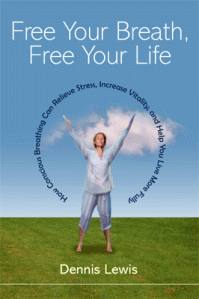
Free Your Breath, Free your Life
Conscious breathing, also known as breath awareness, provides an intimate pathway into ourselves. Breath awareness is practiced in the world’s great spiritual traditions—including, among others, Taoism, Hinduism, Buddhism, Islam, and Christianity—as part of an overall work of spiritual development and awakening. It is also practiced in many meditative, somatic, and therapeutic disciplines for health, self-discovery, and self-transformation. The effort to experience now and here that we are breathing beings in the face of the great mystery of existence is one of the most important efforts that we can undertake on behalf of our own physical, emotional, and spiritual well-being.
Since most of us are almost totally unaware of our breathing, conscious breathing should be the first step in any self-directed program of breathing work. By learning to be aware of our breath, by learning to follow the movements of our out-breath and in-breath consciously in ourselves without any kind of interference or manipulation, we can gain many new insights into the relationship of breathing to our own inner and outer lives.
As breath pioneer Ilse Middendorf writes, “The awareness of breath movement encompasses the physical experience as well as the true nature of the self as we unfold our vital force into the outer world. It is this breath that we allow to come and go on its own which sustains the basic rhythms of our life processes.”
Conscious breathing not only provides a solid foundation for all the other kinds of breathing work, but it is also, in itself, transformational. Conscious breathing helps us cultivate inner stillness and presence. It also helps us be present to ourselves without judgment or analysis. Through becoming aware of how we actually breathe from moment to moment, through sensing and feeling how our breath shapes and is shaped by our emotions, our attitudes, and our inner and outer tensions, we liberate the wisdom of our body and brain to bring about subtle beneficial changes without any ego manipulation on our part.
When you experiment with the following breath awareness practice, especially at the very beginning, be sure to work no more than fifteen to twenty minutes or so at a time in quiet conditions. As you gain more experience with simply following your breath for short periods of time in quiet conditions, you will find yourself becoming aware of your breath spontaneously at other moments throughout the day when it may really be important to do so—for example, in the midst of stressful circumstances. The very awareness of your breath in these circumstances, the ability to follow your breath and observe how it is related to your thoughts, emotions, movements, and postures will, by itself, gradually transform the way you face stress and other difficulties in your life.
Sit quietly now on a chair or cross-legged on a cushion, close your eyes, put your hands together on your lap or put the palms of your hands on your knees, and simply sense yourself sitting and breathing. Allow the actual sensation of your entire body to come to life. Using your sensory awareness, your ability to listen from the inside, take note of your weight on the cushion or chair, the tingling of your skin, the shape and configuration of your body, any muscular tensions, and so on—all at the same time.
Within this perceptual backdrop of a kind of global sensation of yourself, just note what moves in your body as you inhale and exhale. Include the sensation of the air moving into and out of your nose, or any other sensations associated with breathing. If thoughts or feelings or judgments arise about how you could be breathing better, simply include them in your awareness and let them go—instantaneously. Don’t dwell on them or act on them in any way. Don’t try to improve your breathing. Just follow and sense whatever you can of your breath through all the internal sensations, movements, and pulsations of your body.
When you’re ready, stop all your efforts, and simply enjoy yourself sitting there and breathing. Can you begin to sense yourself now as a breathing being?
When you’re finished, just get up and do whatever needs to be done next. During the rest of the day, check in with yourself every couple of hours and note how you are breathing. Just sense and observe. Don’t try to change your breathing in any way.
As you become more aware of how you breathe in the various conditions of your life, of how, for instance, your breath speeds up in stressful circumstances and of how and where it tightens, or how you often unconsciously hold your breath in various emotional states, the light of awareness will by itself begin to alter your breathing in a safe, healthy, and natural way.
Copyright 2004-2010 by Dennis Lewis. These passages from Free Your Breath, Free Your Life (Shambhala Publications, Chapter One, “Ways of Working with Your Breath”) may not be reproduced in any form without the written consent of the author or publisher.
What Are You Looking Out Of?
“And we spectators, always looking at things, never out of something. Who’s turned us around like that?”–Rainer Maria Rilke
“We are always looking AT things. What the blazes are we looking OUT OF?” –Douglas Harding
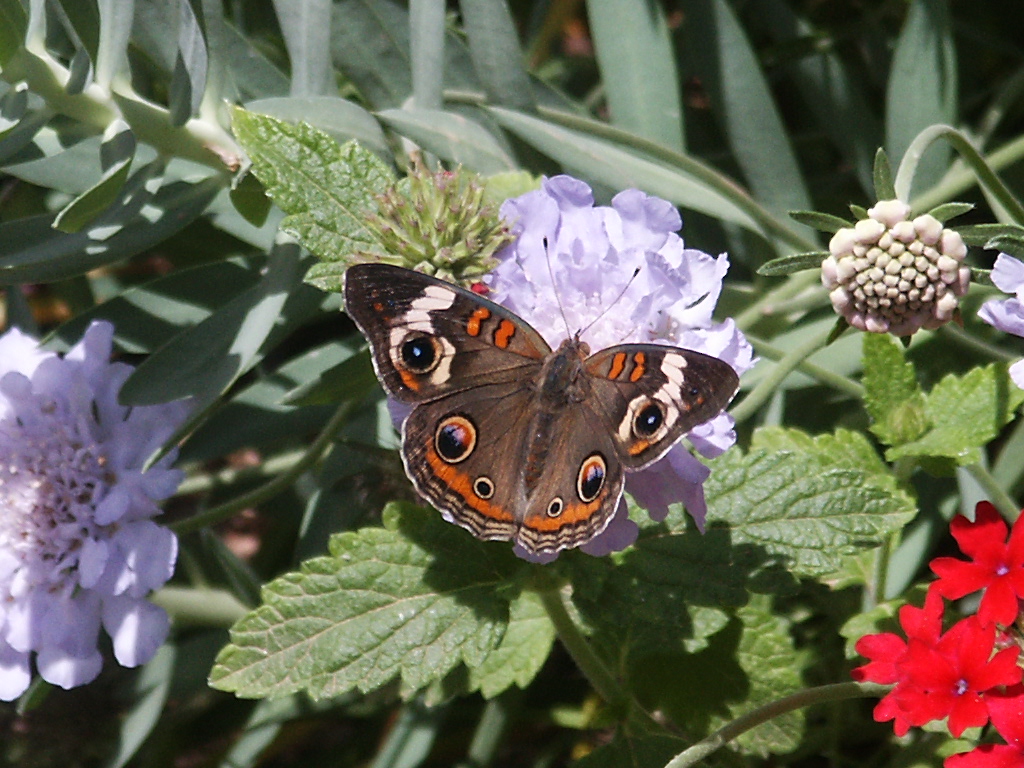 What’s so powerful about these questions from Rilke and Harding is that you can actually “get it” instantly. No explanations, philosophies, theories, and so on–just direct realization.
Of course, these questions, these natural-born koans, must actually be faced, and the looking, the sensing, in two directions at the same time must actually be tried.
So here it is in the simplest terms possible. As you look at the butterfly (click on it to enlarge it), what are you looking out of? Take a good look. No answers needed, nor do they help. Just the actual experience, whatever it is, of what you are looking out of as you are looking at the butterfly (or anything). It’s almost too simple for the mind, but it is possible.
As you try this, do you feel like you’ve been busted wide open? No? Then try again. And again. Eventually–and suddenly–the turnabout, the openness, the recognition of who or what is looking!
This is not a trick. It is not a game. It is a way of living in the light of truth.
“Who am I?”
Copyright 2010-14 by Dennis Lewis.


 Harmonious Awakening