Announcements
Get free breathing and awareness practices, insights, and tips on my Facebook Public Figure Page
The Law of Least Effort in Doing Breathing Exercises

Dennis Lewis
Controlling the breath causes strain. If too much energy is used, exhaustion follows. This is not the way of Tao. Whatever is contrary to Tao will not last long.–Lao Tsu, Tao Te Ching (Translated by Gia-Fu Feng and Jane English, Vintage Books, 1989, p. 57)
So often today I hear from people who have been and are attempting to breathe in a healthier way that their efforts don’t seem to bring them many results, and, in some cases, even make them feel worse. When I talk in depth with them about how they work with their breath, I not only discover that they often have little idea what is involved in healthy breathing (some people wrongly believe that healthy breathing is equivalent to “deep breathing”), but, just as important, I discover that many people use too much physical effort in their attempts at better breathing, however they define it. This is especially true on the in-breath, where many people feel like they have to “grab” air and force it in.
For anyone who is interested in allowing “the breath of life” to animate them more fully, for example in qigong or yoga, it is important to realize that excessive effort actually impedes the diaphragm and secondary breathing muscles and thus makes healthy, harmonious breathing more difficult. It is therefore imperative that anyone who is attempting to work with their breath use the minimum amount of physical effort necessary when doing any kind of breathing exercises and learn how to sense what happens not only in their breathing muscles but also in their entire body when they undertake these exercises. The key, here, is self-sensing and awareness, which I go into in depth in my various books, including The Tao of Natural Breathing, Free Your Breath, Free Your Life, and Breathe Into Being: Awakening to Who You Really Are.
In my book The Tao of Natural Breathing, I discussed the importance of “The Law of Least Effort.” Here is a passage from my book that explains the “psychophysical law” that underlies this discussion:
As we begin to learn how to sense ourselves–especially in relation to our breathing–we will quickly see that the sensation of intense effort in the many areas of our lives often signals a “wrong” relationship not only to what we are doing, but, perhaps more importantly, to ourselves. It is not wrong in any moral or ethical way, but simply because it is counterproductive–it goes against the laws of harmonious functioning. Wrong effort constricts our breathing, cuts us off from our own energy, and produces actions that we did not intend. … It is clear to me today that as we learn to sense ourselves more completely and impartially, we free up the inner intelligence of our minds and bodies to learn new, better ways to accomplish our aims and promote health in our lives.
The Law of Least Effort
To understand how this is possible, it is important to understand that the brain learns and performs best when we use the least possible effort to accomplish a given task. For thousands of years, Taoist masters have emphasized this principle through their advice to use no more than 60 or 70 percent of our capacity in carrying out physical or spiritual practices. The Weber-Fechner psychophysical law demonstrates one reason why this is so important, since it states that the “senses are organized to take notice of differences between two stimuli rather than the absolute intensity of a stimulus.” When we try hard “to do” something, when we use unnecessary force to accomplish our goals, our whole body generally ends up becoming tense. This tension makes it more difficult for our brain and nervous systems to discern the subtle sensory impressions necessary to help carry out our intention in the most creative way possible.
The “law of least effort” is not, however, a license for laziness. Our health, well-being, and inner growth all require a dynamic balance of tension and relaxation, of yang and yin. They depend on the ability to know through our inner and outer senses what is necessary and what is not in our efforts and actions. To sense ourselves clearly, we need to be able to experience a part or dimension of ourselves that is quiet, comfortable, and free of unnecessary tension. It is the sensation of subtle impressions coming from this more relaxed place in ourselves that allows us to observe and release the unnecessary tension in other parts of ourselves. In short, effective action requires relaxation. But this relaxation should not be a “collapse” of either our body or our awareness. It is more like the “vigilant relaxation” of a cat. Vigilant relaxation makes it possible to manifest the appropriate degree of contraction–the life-giving tension called “tonus”–in any given situation.
I hope this discussion of “The Law of Least Effort” and the Weber-Fechner psychophysical law (the law can be found on page 48 of Peter Nathan’s book The Nervous System, Oxford University Press) helps you understand (at least to some extent) why, if you want real, lasting results, it is so important to work as gently as possible with your breathing–especially when you are working on your own. When you put yourself in the hands of a body worker or breathing therapist, of course, he or she may work on you in necessary ways that are not always gentle. But when you do breathing exercises on your own, it is your inner sensitivity and awareness, combined with right intention and knowledge, that will eventually bring about any necessary changes. Self-inflicted force and manipulation, including tension-filled efforts to breathe deeply, will not only seldom help, but in many cases will only cause further problems.”
Many people do breathing exercises today, especially those involving breath control (pranayama), and, as I have pointed out in my books and articles, these practices can cause harm when done prematurely or without proper guidance. Many people today simply have too little body awareness and understanding for the advanced breath control exercises they read about or are given. They often walk into a yoga class that has people of varying levels of experience both teaching and taking the class and are given pranayama exercises that may be totally unsuitable for them at that time.
An even more fundamental problem is that the mind doesn’t really have a clue about how to direct the body to breathe in a harmonious and balanced way for the particular situation of one’s health and life. Carrying out various counting and breath-holding exercises that one has learned on the Internet or from a video or book, for example, and often doing so with excessive tension in order to reach the count, is the height of absurdity, especially for people filled with stress and tension. To be sure, when one interrupts one’s habitual breathing patterns, one often feels better initially. But this feeling may well mask the negative impact that such exercises can have on our breathing in the long term. One good example is advanced breathing exercises involving breath holding, where one tenses in order to hold the breath. This can create more tension in the diaphragm and secondary breathing muscles and seriously undermine the overall functioning of your breathing muscles. Advanced breath control exercises for increased health, energy, and other goals can be beneficial for those who already breathe in a natural, relaxed, and harmonious way, but they are contraindicated for those who do not already breathe naturally.
So, if you are one of those who does breathing exercises on a regular basis, especially exercises involving so-called deep breathing, I suggest that you sense your body/mind as honestly as you can and do far less than you believe is possible for you. When you experience any kind of tension as you breathe, you are probably doing too much. The recent adage “less is more” applies in this case. The less tension you have, the more you will be able to discern both what is going on in your body/mind and what is actually needed.
Copyright 1997-2009 By Dennis Lewis. All rights reserved. This article, which is an edited and expanded version of an article that appears on the Authentic Breathing Resources website, may not be reproduced for any purpose without written permission from the author.
I decided some time ago that when my new book Breathe Into Being: Awakening to Who You Really Are came out I would visit bookstores only in Arizona and California. Since there are fewer and fewer good independent bookstores and since the large chains seem to do less and less for relatively unknown authors like me, this was a sensible decision, especially for a niche book like mine.
My wife, Dasha, would have loved to come with me, but she had just returned from three weeks visiting her family in the Czech Republic and couldn’t take any more time off. So, after some book signings in Arizona, I set off for Southern California alone in my trusty SUV (ah, yes, I drive a relatively large, comfortable vehicle to help safeguard my neck and back that were injured a few years ago in a hit and run rear-end collision) on Monday, June 22nd and stayed that night and the next day five minutes from Bodhi Tree Bookstore at the home of one of my students from Esalen who so graciously offered me the use of her pool cabana. In San Francisco, I stayed for three days with a good friend I have known since the 1960s. And there were, of course, a couple of motels along the way and back (I will not drive more than 6 hours at a time), where I felt comfortable, in spite of the uncomcortable beds, in the solitude they offered.
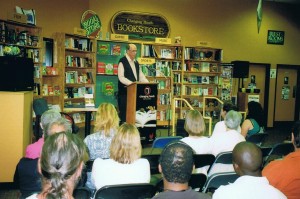
My Book Event At Changing Hands Bookstore
The book events at the independent stores went well for the most part, but with many surprises. Some of the old friends and acquaintances I invited and thought would come, didn’t show up (nor did I ever hear from them). Others I had not expected to see, did show up. Then there were many people I didn’t know but who were very interested in the relationship of breath to awakening, and we had some excellent exchanges based on some very tough questions.
At one of the large chain stores in San Jose CA, however, no one showed up for the first 10 minutes of the event and then after the store announced my event for the third time six people drifted over and sat down. It turns out that three of these people really needed to learn about the relationship of breathing to health (a couple of them had serious stress and breathing problems), so I radically modified my presentation and gave them practices that could help with their problems. It feels great when I can actually help someone in need, and they were very appreciative. In spite of the small number of people at the event, they purchased many of my books.
I arrived at the National Qigong Conference (Asilomar, Pacific Grove, CA) on Sunday morning 30 minutes before my scheduled qigong workshop there. Though I missed the morning session in which all the presenters would be introduced (I had asked when I arrived if there was a meeting before the presentations started and was told “none was scheduled”), ten brave (since they hadn’t met me yet) souls showed up for the workshop anyway (it turns out that several of them had read my books and journal).
At the workshop, I presented a very simple yet powerful qigong form that I had created and practiced over many months called “Humming Breath Qigong.” Midway through the workshop, one of the people suggested that I call the form “Humming Bird Qigong,” and most of the others agreed (still not sure which name I’m going to end up with). Having taught and taken workshops at many NQA conferences in the past, and having experienced the fact that many teachers give their students far more than they can learn and thus end up creating unnecessary tension and frustration, I felt that this new form would be perfect for the three hours we had together. And it was. Everyone loved the form and learned the postures and movements very quickly (the inner dimensions of the form can take many weeks or months to understand and appreciate). One of the participants, who teaches qigong, has since sent me a verbal description of the movements, along with drawings, which I am in the process of editing and will eventually make available to anyone who takes the class. She also asked for my permission to teach the form and disseminate the notes to her students. All in all, this was one of the best classes I have ever taught, especially so because all the students were serious, attentive, and open to having fun as we worked together. It was also a huge help that they had all worked in one way or another with body awareness.
Getting back to trying to teach too much too quickly, I have to thank Bruce Kumar Frantzis, an amazing teacher with whom I studied qigong and tai chi for several years. Bruce taught all of us the importance of The Taoist 70 Percent Rule, which continues to prove itself invaluable in my own learning and teaching. Following this rule–never going beyond 70 percent of what one could maximally do–one remains well within the limits of one’s brain and nervous system to learn new activities and make the adjustments in balance that are always necessary, and thus eliminates the unnecessary stress, tension, and disharmony that would otherwise arise. As a result, in-depth awareness becomes much more possible, and people learn in a deeper and faster way than they would otherwise.
Much of my trip, of course, involved driving, some 1700 miles total from Scottsdale to Southern California, Northern California, and back. Along the way, of course, many opportunities to remain present and keep breathing in the midst of the usual experiences of traveling by auto: schlepping luggage into and out of the car, impatient drivers, bad roadside food, exorbitant gas prices in some places, radio music and news filled with static, long boring stretches where it was difficult to remain awake, almost impossible mazes of freeways, turnoffs, and overpasses in the LA area (even with the help of a GPS unit it was not always easy to get where I wanted to go), and much time alone with my own drifting thoughts, feelings, and sensations (including those related to my aching back). I stopped, though, every hour or so to stretch, move around, and relax, mostly at established “rest stops.” It is noteworthy, however, how much effort it sometimes took to “stop,” since the natural momentum of driving and the desire to get to my predetermined destination were almost irresistible forces.
Also along the way some great conversations with old friends. And a wonderful dinner with my son, Benoit (though the food wasn’t as good as I had remembered it to be when Benoit and I used to go there many years ago), who just happened to be visiting San Francisco with his boyfriend, whom I met for the first time and really liked. Both of them came to my Field’s bookstore event, and Benoit asked a very important question–both for him personally and the others. When I admitted in partial response to his question that the more I realized through the years that I didn’t understand everything about my son the closer we became, one of the mothers who was there with her daughter (who had gone to school with my son at the French American School), said something like “He’s your son, you should understand him. I certainly understand my daughter” (an assertion that came into question later during a private conversation I had with her daughter). I replied, though I don’t remember my exact words, that although I understood my son at a certain level, there was much I didn’t understand, and that it was just this attitude of believing that we understand others or “should” understand them, even our children, that prevents us from opening to who they really are for themselves and that also constricts their lives.
It was a wonderful trip, filled with many new impressions of people and places and myself, and, though I felt at home wherever I was, I was very happy to return home to the smiles and hugs of my wife, Dasha.
I Know What I’m Doing

Mulla Nasreddin On His Travels
One day the Mulla decided to cut a long, thick branch off a tree in his front garden. The branch blocked the surrounding view from his neighbor’s house and his neighbor had been complaining to him on a daily basis.
Though the Mulla was tired that morning and didn’t feel much like working, he was also very tired of hearing his neighbor complain. So he finally took his saw, climbed as carefully as he could up the tree, sat down (facing the tree) on the branch that was causing the problem with his neighbor, and began sawing. As he did so, a stranger passing by noticed him, stopped, looked more closely, and then shouted out: “Hey there. If you continue sitting where you’re sitting and sawing that branch, you’re going to fall down with it. I suggest that you get closer to the tree trunk, turn to face away from the tree, and finish cutting the branch off in front of you so that when the branch falls, you won’t.”
Now, considering himself a wise man in his own right (after all, didn’t many people come to him for advice?), Nasreddin resented being told what to do. “Thanks for the advice, but I know what I’m doing,” he replied without even stopping for a moment to consider the logic of what the man had said, while thinking to himself that he didn’t really appreciate people going around telling other people what they should and shouldn’t do, and that he really wanted to finish the job so he could go back into his house and take a nap.
In growing irritation that this stranger had the audacity to tell him, the incomparable Mulla Nasreddin, what to do, he began to saw much faster. A few minutes later, when the branch finally gave way, Nasreddin suddenly found himself in a heap on the ground, still on top of the branch he had been cutting.
Startled, in pain everywhere, and confused about what had happened, the first thought that came into his mind was, “My God! that man knows the future.” He was going to run after him to ask him other important questions about his future, incuding when he would die, but the man was nowhere to be seen. “Well, that’s okay,” the Mulla said to himself. “I’m sure he’ll pass this way again. I’ll ask him then.” He then went back inside and took a long nap.
(Retold by Dennis Lewis from the vast panoply of Mulla Nasreddin stories. Illustration from Wikipedia.)
An interview with Dennis Lewis, author of The Tao of Natural Breathing; Free Your Breath, Free Your Life; Natural Breathing (audio program); and Breathe Into Being: Awakening to Who You Really Are
Dennis Lewis
You’re walking along a beautiful beach and you find yourself filled with tension and anxiety. You’re sitting at home trying to relax and you find yourself fearful and apprehensive. You’re talking to a friend on the phone and you notice that you’re irritable and out of sorts. You’re at work and you just cannot concentrate. Time to go for psychotherapy? Not necessarily—at least not according to Dennis Lewis, the author of the highly acclaimed books The Tao of Natural Breathing, Free Your Breath, Free Your Life, Breathe Into Being, and the three-CD audio program Natural Breathing.
Lewis maintains that negative emotional experiences such as anxiety, worry, and so on can be the result of excessively fast breathing–also referred to as “over-breathing.” This kind of breathing, called hyperventilation, often occurs when we take quick, shallow breaths from the top of our chest. It also frequently occurs when we breathe through our mouths. He points out that although the average text book breathing rate for people at rest is about 12 to 17 times a minute, many of us breathe even faster than this. And when we do, we will generally find ourselves anxious, irritable, apprehensive, and even fearful—all for no apparent reason. He also believes that even the breathing rate of 12-17 times a minute is often faster than it needs to be and is itself often a subtle form of chronic hyperventilation. “People who undertake qigong (chi kung), tai chi, yoga, breath therapy, or other such practices, often reduce their breathing rate to between 4-10 breaths a minute,” as well as their levels of stress and anxiety.
“It’s important to understand the role of carbon dioxide in helping to ensure the efficient utilization of oxygen in the body, which is absolutely imperative for maintaining good health. When our breathing rate is too high, that is, when we breathe too fast,” Lewis explains, “we reduce the level of carbon dioxide in our blood below its optimum level. This reduced level of carbon dioxide causes many problems. For example, it causes the arteries, including the carotid artery going to the brain, to constrict, thus reducing the flow of blood throughout the body. It also makes it more difficult for the red blood cells to release oxygen to the cells of the brain and body. When we have too little carbon dioxide, our brain and body will experience a shortage of oxygen no matter how much oxygen we may breathe into our lungs. This lack of oxygen switches on the sympathetic nervous system—our ‘fight or flight’ reflex—which makes us tense, anxious and irritable. It also reduces our ability to think clearly, and tends to put us at the mercy of obsessive thoughts and images.”
According to Lewis, however, the effects of chronic hyperventilation (a breathing rate that is too high) go far beyond mental and emotional symptoms such as anxiety and fearfulness. Lewis states that some researchers and medical doctors, including Professor Konstantin Buteyko from Russia, now believe on the basis of many studies that the overly high breathing rate of chronic hyperventilation is instrumental in some 200 medical problems and diseases, including asthma, heart disease, high blood pressure, chronic fatigue syndrome, irritable bowel syndrome, memory loss, sinusitis, arthritis, panic attacks, stress, rhinitis, headaches, heartburn, and many more.
Lewis points out that although chronic hyperventilation can be the result of underlying emotional or psychological problems, it can also be the result of bad breathing habits formed in childhood. One such habit is mouth breathing, which releases huge quantities of carbon dioxide very quickly. It is very important, therefore to learn how to breathe only through your nose is the normal activities of your daily life, including when you are doing aerobics. Chronic hyperventilation can also be the result of poor posture, excessive muscular tension, poor diet, and the prevailing image of the hard, flat belly that we find in fashion and fitness magazines. To breathe naturally, says Lewis, is to breathe with our whole body, the way a baby or animal does. For this to occur, we not only need a flexible, unconstricted ribcage, but also a supple belly. Our belly needs to be able to expand on inhalation and retract on exhalation.
According to Lewis, this bellows-like movement of the belly supports the upward and downward movement of the diaphragm. When the belly expands on inhalation, the diaphragm can expand farther downward into the abdomen, which allows the lungs to expand more fully. When the belly retracts on exhalation, the diaphragm can relax farther upward helping to empty the lungs. The diaphragm’s increased downward and upward range of movement not only allows the lungs to take in and release air (including oxygen, carbon dioxide, and other gases) with fewer, slower, more-coordinated breaths, but it also helps to massage all the internal organs. This “internal massage,” says Lewis, has a healthful impact on digestion, elimination, blood flow, the immune system, and the nervous system, reducing overall stress and anxiety.
Lewis, the cofounder of a highly successful technology-related business, has been studying the breathing process for the last 30 years in a variety of disciplines. After he sold his business several years ago to a large English firm, he found himself with an abdominal pain that his doctors could neither diagnose nor cure. During this period, he met a body work practitioner who was able to alleviate the problem in several hour-long sessions. This practitioner used a technique called Chi Nei Tsang—a form of internal-organ energy massage and breathwork brought to the West by Taoist master Mantak Chia. Lewis found this approach so helpful that he went on to become a certified practitioner and worked for a couple of years in a well-known acupuncture clinic in San Francisco.
Lewis says that it was his experiences with Chi Nei Tsang that inspired him to write his first book, The Tao of Natural Breathing, and develop his audio program Natural Breathing, which bring together the meditative wisdom of the East with the scientific knowledge of the West with regard to breathing. “As I began working on ordinary people with various physical and emotional problems,” says Lewis, “I saw that many of these problems, including anxiety, were often related to their breathing. I also saw that most of us are unaware of our bad breathing habits and have little understanding of how these habits undermine our health and well-being.”
Lewis says he wrote the book and developed his audio program so that people could begin to explore this important subject for themselves. “Breathing exercises are a dime a dozen,” says Lewis, “especially advanced exercises such as breath retention, fast alternate nostril breathing, and reverse breathing. You can walk into almost any bookstore and find a variety of books and tapes promoting such exercises. What you can’t usually find in these stores, however, are books and tapes with a clear understanding of natural breathing and of how the way we breathe, including our breathing rate, relates to the various inner and outer aspects of our lives—not just to the amount of oxygen we take in, but also to our ability to ward off disease, to think clearly, to sense and feel the needs and emotions that are motivating our behavior, and so on. Until we begin to have this understanding, and until we begin to have some experience of natural breathing, many breathing exercises can actually be detrimental to our health and well-being.”
One example that Lewis gives of how breathing exercises can be detrimental to our health is the many deep breathing exercises that people often do. “Deep breathing is not the panacea it is made out to be,” says Lewis, “especially when it is forced. Many people in today’s world don’t have sufficient body awareness, diaphragmatic strength, and breathing coordination to intentionally breathe deeply without hyperventilating. People who try to breathe deeply often end up by pulling their bellies in and trying to expand their chests, which is just a very inefficient and unhealthy form of shallow breathing, which speeds up the breathing rate. Such deep-breathing exercises improperly done in this or other ways can bring about even more hyperventilation and anxiety, weaken the diaphragm, and cause disharmony in the breathing muscles. In any case, our breathing was never intended to always be deep, but rather to be spontaneously and naturally responsive to the needs of the moment.”
The Possibility of Self-Knowledge
People frequently talk about the possibility of self-knowledge. Numerous books have been written on the subject, and one sees it brought up on Internet discussion groups about this or that teaching or teacher. Yet, when you look closely, you see that the subject of self-knowledge is often presented in an abstract, disembodied way, as though thinking about the inner and outer dimensions of one’s being is more important than actually experiencing them.
My own experience of self-knowledge, or what I often call direct self-knowing, includes not only my many sometimes “messy” manifestations of sensing, feeling, thinking, and behaving, as well as what I can observe of the relationships among them, but also, and behind all these manifestations, presence itself. Sensations, feelings, thoughts, and actions are continually changing, but the presence, the light, in which they are experienced (when they are actually experienced first-hand) seems somehow to be changeless. For me, direct self-knowing is intimately related to the changeless presence that lies at the heart of being.
A couple of years ago, I included on one of my websites the following experience of direct knowing—an experience that has visited me in many different forms over these past years. Perhaps this experience can help convey what I mean:
“It’s 6:30 AM. I’ve just woken up. The first sensations of my body are relaxed and comfortable as the visual remnants of my last dreams vanish. Thoughts in the form of questions and ‘shoulds’ begin to arise: what’s happening with the war in Iraq?; I should get up and go to the other room to meditate; I should get the paper and read it. The arthritic pains I have lived with for the past 20 years begin to enter my awareness. I sense the habitual urge to get up and get moving. Perhaps that will help. Somehow I close my eyes instead and allow my attention to move deeper inward, toward the unknown center without losing awareness of the thoughts, feelings, and sensations on the periphery. I touch something that I can only call Being—a subtle, pervasive, energetic sense of I Am, without being anything in particular. This energetic sense of I Am is both very familiar and very new. A direct knowing that I cannot objectify in any way. Somehow I know that that is what I am. And with it comes a new sense of freedom.”
 Now, of course, this is just one of many possible ways to describe the essentially indescribable experience of direct knowing. Lao Tsu said: “The nameless is the beginning of heaven and earth. The named is the mother of ten thousand things.” Once we start naming “things,” which, of course, is an inevitable aspect of being human, thought takes over and “things” seem to multiply and become more complex. There is obviously great power in naming things. The world we see around us, with all of its many tremendous problems and contradictions, is very much the result of this power. We find ourselves seduced by constant naming, judging, analyzing, and so on, by “taking sides,” and easily forget that it is from the “nameless” that all things arise, from the silent ground of being that Max Picard refers to when he says “In every moment of time, man through silence can be with the origin of all things” (The World of Silence).
To free ourselves from the power of this seduction, however, what is necessary is to allow our attention to move, to expand, in two directions at once: toward the periphery in which naming is the norm, and toward the center, toward the nameless silence and stillness that makes the experience of all things possible. We don’t have to try to rid ourselves of the tendency to name things, which for most of us would be a futile endeavor; we only have to be present to it. It is presence, the inner welcoming of impressions of what is, that brings with it the self-knowledge, the direct knowing, that many of us wish for.
Going Beyond the Mind: Seeing the Truth in Action
There are many people who assume that spiritual work is mostly of the mind. One can go to satsangs, spiritual talks, and other such events and hear inspiring words about presence, self-realization, love, egolessness, non-duality, and so on. At such events, one will invariably notice the affirmative nods and smiles of most of the listeners, who clearly like what they hear. If, however, one consciously (or unconsciously) steps on the corns of some of the people attending such events, one quickly sees that not all is as it seems.
For example, after one such gathering–led by a well-known spiritual personage–someone I knew from a teaching I had studied for several years came up to me with a smile on his face and said “Hello, Dennis,” which I appreciated. Unfortunately, I couldn’t remember his name. When I told him that I had forgotten his name, a dark cloud, a frown, flashed across his face, which, after several moments, turned back into a smile. Now I am all for smiling (I write about the importance of smiling and “the smiling breath” in many places), but it was clear to me at that moment that his smile was an effort to cover up his irritation and maintain the image that he had of himself. Perhaps he saw this identification with his self-image, and, if so, that is all anyone can ask.
Another time I was waiting in line to get my room assignment in San Francisco at the Whole Life Expo for a talk I was giving. The person in front of me was a well-known spiritual author and teacher. She had a huge smile on her face and was a paradigm of calmness. When the woman giving the assignments told her which space she was going to be speaking in, the teacher erupted with disbelief, irritation, and tension. “I cannot be in that room,” she said. “I want a better room. It’s impossible to teach in that room.” After about ten minutes of checking and rechecking what other spaces were available, she finally got her way. And, with a huge smile, headed off toward her talk. Did she see herself impartially during that exchange? I have no idea.
But that is by no means the end of the story. Who do you think got the space she had just rejected? Why, me, of course. And she got the space that was originally assigned to me. There was a certain spiritual justice about that since my talk was entitled Awakening to the Miracle of Ordinary Life. This indeed was “ordinary life”! When I walked into my newly assigned space, which happened to be quite large and noisy (with people walking by to get into other rooms), I saw why the other teacher hadn’t wanted it. But I also realized that this was a perfect situation for what I was going to be speaking of. So a certain calmness came over me and I discovered an entirely new way not just to speak (so that I could be heard) but also a new way to be in relation to the various thoughts, emotions, and sensations that were arising as I spoke. A great sense of inner freedom appeared, the freedom to welcome the truth.
Before any of these events took place, I had been seriously involved in the Gurdjieff Work in San Francisco for some 18 years. In “The Work,” as it was called (not to be confused with Byron Katie’s teachings), we worked with, among many other things, learning how to observe with absolute sincerity the energies and manifestations of mind, body, and emotions. And this work was not just a matter of listening to people speak, thinking about the teaching, and so on, but of actually testing our understanding and presence in the midst of intense activities with others, where, in fact, our corns were stepped on frequently. It wasn’t a matter of what we liked or didn’t like—in fact, Gurdjieff made clear that identification with our likes and dislikes was a big part of our inner slavery, our sleep. No, it was a matter of actually observing this process in action and, through these observations, discovering the power and clarity of consciousness itself. And the teacher did not just speak beautiful words and express great ideas while we listened (though that did happen), but also put us to the test in many ways. What was at stake was not just our mind but our entire being. Perhaps this little story will help convey a sense of what I mean.
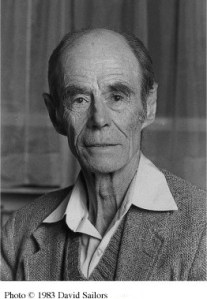
Lord John Pentland
I had been involved with the San Francisco Gurdjieff Foundation for three or four years, and I had gone to New York from San Francisco to take part in some special work activities there: group meetings, sacred dances, meditation, physical labor, and much more. Lord Pentland, who had worked with both P.D. Ouspensky and G.I. Gurdjieff and was the president of the New York Gurdjieff Foundation, invited me to his home outside the city before the organized events began, as he often did. When I arrived, he immediately put me to work raking leaves in his rather spacious yard. He instructed me to take the leaves I raked and dump them over the fence in an adjoining vacant lot, which already contained many piles of leaves. He then told me in no uncertain terms that my inner task was to be present to myself as I raked the leaves, to actually sense and observe what was going on in my inner and outer worlds.
After a couple hours of working in this way, and having found a comfortable sensation and rhythm of raking while taking in the smells that reminded me of raking leaves when I was a teenager in Wisconsin, I suddenly smelled and saw smoke coming from the lot where I had been dumping the leaves. I quickly threw the rake down, ran over to the fence, and saw that the leaves were in fact on fire. I also noticed that there were some houses that seemed very close to the fire. In near panic I ran back to Lord Pentland’s house and pounded excitedly on the front door. It took him what seemed like an eternity to come to the door and open it. When I told him about the fire, he slowly took a couple of steps outside, peered at the smoke that was visible over the fence, looked calmly back at me, remained silent for a minute or two, and then in a very calm yet serious voice said: “I told you that your only task was to stay present to yourself as you raked the leaves. Continue raking but don’t throw the leaves over the fence. I’ll take care of the fire.”
In great turmoil, partly because of the fire, but also because I had become so completely identified with my emotions of anxiety and fear and didn’t want to be seen by my teacher as having “lost it” (though I realized that I had), I continued raking the leaves. And in the midst of all the impressions of both the turmoil and my wish to follow my teacher’s instructions, I was brought back to the reality of how little relationship there was between what my mind believed it knew and my actual understanding. I saw my functioning and my being as it actually was. Within a few minutes, a fire truck arrived and put out the fire, which, in fact, turned out to be a rather small one. The houses that I had thought were so close to the fire were never threatened and, when I looked later appeared now to be much farther away than I had imagined.
Now, of course, you, like me, might assume that Lord Pentland started the fire for my benefit. And perhaps he did. But I never asked him. What I had learned that day was far too valuable to link up with my ego belief that I was somehow special enough for him to take this action on my behalf. The fact is, I don’t know. After the event was over, I remembered some kids playing around in the space. Perhaps one of them started the fire. But it really doesn’t matter, for life itself is constantly providing shocks that can help us awaken from our sleep. But what is our attitude when these shocks actually appear? It is in the face of this living question that there is a possibility to see and welcome the truth that is being revealed now, and to discover that it is the welcoming itself, the willingness to receive impressions of life just “as it is,” that is who or what we are at the deepest level of being. For me, at least, when this welcoming appears there is a deep sense of returning home.
An Exploration Into Reading Wisdom Literature
Dennis Lewis
For many of us, reading is a highly mechanical act, an automatic reflex that kicks in when we have some spare time, are bored, are excited by what we have heard about this or that latest book, or have a genuine interest in the subject. We may find ourselves reading spiritual classics while sitting on the toilet, lying in bed, standing in line, or eating a meal. On rare occasions, we may realize that reading the great wisdom literature is very much like meditating, and that it requires special inner and outer conditions.
Many of us are great believers in our own powers of discernment, and we are more than willing to share our view and even argue with others after only a few minutes or hours of reading a book that an author may have struggled for many months or years, sometimes with great suffering, to write in the truest way possible.
What we perhaps often forget is that in reading a spiritual book we are establishing a relationship with its author. We are opening ourselves to receive perceptions, insights, impressions, ideas, experiences, principles, methods, and even the joy and suffering of the person who wrote the book. And like all real relationships, listening is required, a willingness to receive what is being communicated without suggestibility and without immediately interpreting it in relation to what we think we know or understand. We need to find a silent, open place within which to receive and ponder what is being said. If we cannot find such a place, at least we need to observe, impartially, the point of view from which we are reading or listening, so as to see how it is shaping what we hear and experience.
Some time ago, I wrote a short essay entitled Reading & Silence. I am including it here to help us go deeper into this question. All the quotations within this passage are from The World of Silence, by Max Picard, itself a wonderful representation of wisdom literature.
“‘Today words no longer arise out of silence, through a creative act of the spirit which gives meaning to language and to the silence, but from other words, from the noise of other words. Neither do they return to the silence but into the noise of other words, to become immersed therein.’
Those of us who still read in pursuit of meaning are faced with a paradox. On the one hand, many contemporary writers of so-called wisdom literature today have little understanding of the relationship of language to silence, and so are little able to awaken the silence in us. On the other hand, most of us as readers have little direct experience of the ‘substance of silence’ in ourselves, and so the words we read fall only on other words and simply increase our own internal noise.
If reading is to be more than a diversion or exercise for the mind, we must find a new way of reading, a way which helps us experience the origins of language and thought both in the writer and in ourselves. For as Picard makes clear: ‘In every moment of time, man through silence can be with the origin of all things.’ Allied with silence, man participates ‘not only in the original substance of silence but in the original substance of all things.’
At its best, reading helps us to participate in a primal process of creation and discovery. In reading the great wisdom literature, the words or works of Lao Tzu, Buddha, Jesus, Milarepa, Socrates, Plato, Gurdjieff, and so on, one can hear, if one knows how to listen, an underlying call to return to this original substance of silence where deep contemplation and participation can arise. But most of us most of the time are unable to hear this call. We have little practice in listening within as we read. And so we read only words, and the words bounce off of one another and our memories and associations and seldom reveal their inherent power to awaken us to new levels of ourselves.
One might wish to undertake an experiment here, an exercise, to help us listen, and, of course, there are many useful exercises one can try. But the problem with such exercises is that we most often read and hear them in much the same way we read our books–mechanically, with little real presence.
What is presence? What would it mean to be present to ourselves not only as we read but as we do everything else that we do? There is a mystery here, another paradox. To be present, to consciously participate in the creative flow of life, I must return to the original substance of myself and all things; I must return to the unknown, to the ‘uncarved block,’ to the vast underlying silence of myself.
How will I undertake this return? Where will I turn? Am I really interested? Perhaps these questions will take on new significance as I learn to read with presence in my pursuit of meaning.”
Copyright 2009 by Dennis Lewis. This essay appeared in the review section of the March/April 2009 issue of The Journal of Harmonious Awakening, which is no longer being published.
The Mystery Is Still Alive
Back from Esalen. Five days with an amazing group of some 20 people all exploring the miracle of the breath–the breath of presence.

Free Your Breath, Free Your Life--Esalen 2009

Ella's Last Day
Out-breath, letting go into the silent spaciousness that is what we really are; in-breath, being filled with the energies and forms of life. I am still here and the mystery is still alive as changes take place in and around me.
Ella’s Last Days of Unconditional Love

Ella in 2008
In spite of her fast-deteriorating condition, she still plays with us when she has the energy, goes on walks with us (albeit it at a very slow pace), wags her tail profusely when friends come over, helps Dasha welcome and heal her acupuncture clients, and reminds us always of the power and mystery of unconditional love.
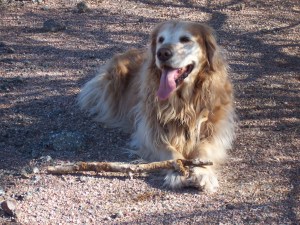
Ella simply waiting in openness
Guided by observation, intuition, and the advice of her doctor (with whom she is very comfortable), we will take her to the clinic on Friday, April 24th at 4 PM to finally relieve her suffering. Benoit, who loves her very much, will fly in from Boston to be with her during her final moments on this earth.
As I write this, I am in tears—not only from the stark fact of her impending death (of course, we and everyone we know are going to die) but also from the happiness and joy that she has brought us and all those she has met for almost 14 years. Her wagging tail always felt (and feels) to me like a great smile from being itself, a reminder of the awakening power of unconditional love.
Ella, thank you for the tremendous gift of your being! Though you will never read this, I know that you feel what is in my heart.
Taking a Leap Out of Fast-Forward
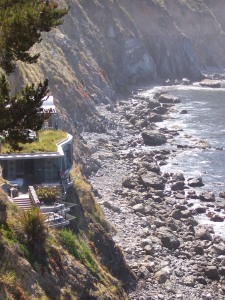
Esalen--View of Hot Tubs & Ocean
Though the retreat this year will explore some safe, natural, and powerful ways to open up our breathing, the underlying aim of the retreat is awakening to our real nature–being present to who and what we really are with the help of the breath.
To understand the implications of this aim it is imperative to see that so many of us live our lives in fast-forward, attempting to escape the pain, discomfort, anxiety, uncertainty, messiness, or boredom of the present moment by dwelling on something in the future that we believe will bring us meaning and happiness. When we are honest with ourselves, however, we see that the future always arrives now, which we are constantly trying to escape, and that so much of our life is spent fast-forwarding and never really being where we actually are.
The breath can be a tremendous help here, as I describe in The Tao of Natural Breathing and Free Your Breath, Free Your Life, as well as in my new book (due out in the next couple of weeks) Breathe Into Being: Awakening To Who You Really Are. For we are always being breathed now. And the breath of life that enlivens us arises from and returns to the unknown.
Perhaps you can take a moment right now to notice the miracle of your own breath–the aliveness that it brings. This noticing will help bring you back into Now, the only time that actually exists. You may notice as you pay attention that this Now is much bigger than the now that you habitually rush through. It is at least big enough to include both your out-breath and your in-breath–and much more as you begin to be called to the living experience of presence. But it takes a leap to be present to the miracle of being, a leap out of the the mindset that always thinks it knows what the next step, the future, is or should be.


 Harmonious Awakening